

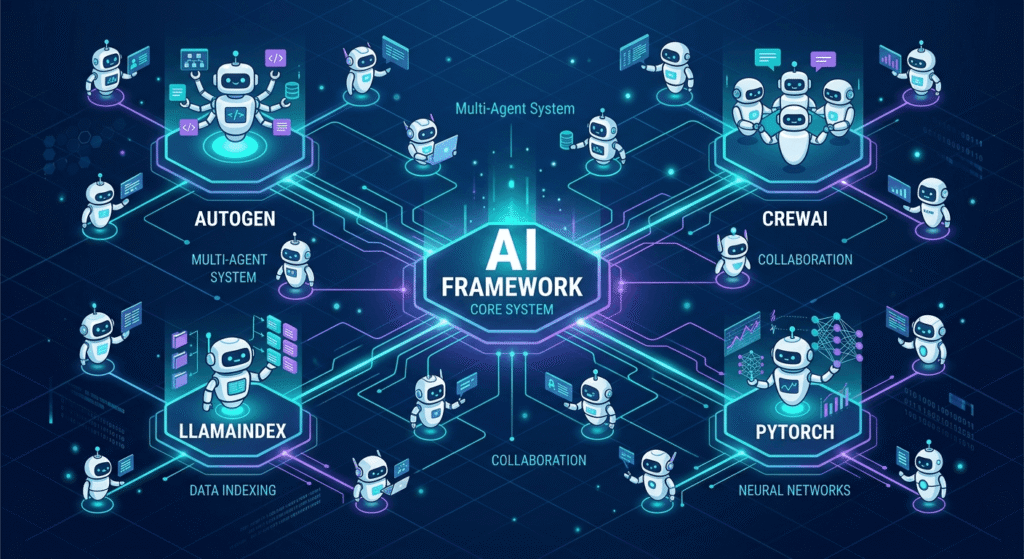
Quick Answer Box: AI agent frameworks are specialized software platforms that coordinate multiple intelligent agents to achieve complex tasks. Unlike traditional AI frameworks, AI agent frameworks emphasize collaboration, automation, and seamless tool integration, making them the backbone of advanced enterprise and large language model (LLM) solutions in 2026.
What is an AI Agent Framework?
An AI agent framework is a software platform that organizes, manages, and coordinates multiple intelligent agents to automate or collaborate on tasks. These frameworks go beyond traditional machine learning platforms by focusing on how multiple agents communicate, execute multi-step processes, and integrate with a variety of external APIs and tools in dynamic, real-world environments.
Types of AI Frameworks: Agentic vs. Traditional
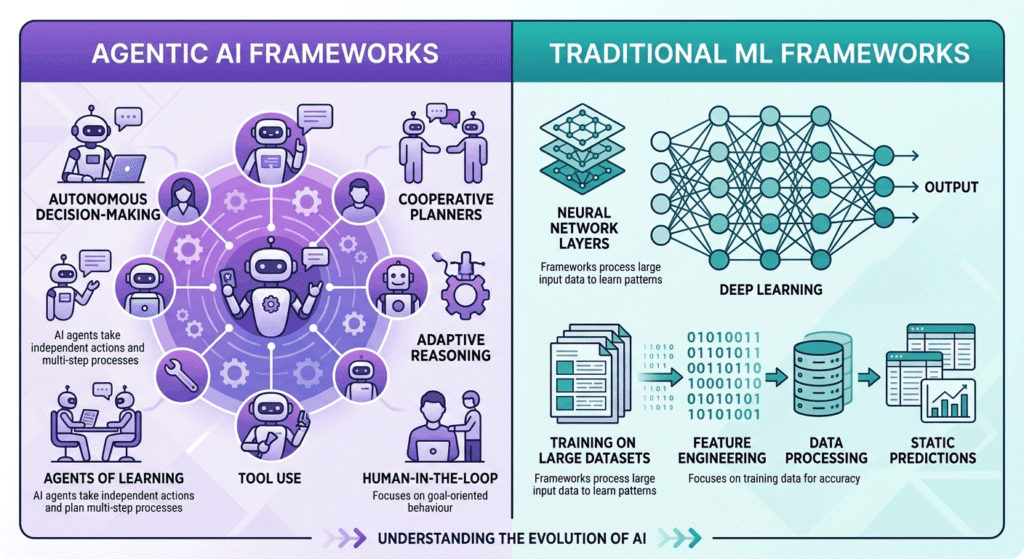
AI frameworks are generally divided into agentic frameworks and traditional frameworks. Agentic frameworks, such as AutoGen, CrewAI, and LlamaIndex, empower you to design systems where multiple agents handle distinct roles or interact with APIs, external data sources, or users. Businesses leverage these frameworks to automate multi-step workflows or deploy LLMs in production-grade systems.
Traditional frameworks, including TensorFlow, PyTorch, and scikit-learn, are designed to help build, train, and serve machine learning and deep learning models for tasks like classification, regression, computer vision, and natural language processing. These remain foundational for AI research, experimentation, and production model deployment.
Agentic vs Traditional AI Frameworks in Practice
Agentic frameworks are the go-to for organizations with complex workflow needs, requiring orchestration across many tools and APIs, such as customer support automation or enterprise analytics pipelines. Traditional frameworks are optimal when the primary need is raw, algorithmic model development or classic ML projects. For example, a startup building a chatbot with LlamaIndex will rely on agentic coordination, while researchers training novel neural networks typically choose PyTorch or TensorFlow.
Overview of Top AI Agent Frameworks
In 2026, the landscape of AI agent frameworks is robust and diverse, catering to a wide range of business and research needs:
- AutoGen (Microsoft): Premier open-source agent orchestration, with enterprise-ready role management, workflow connectors, and compliance-centric features. Now central to the Microsoft Agent Framework, it integrates closely with Semantic Kernel.
- Scikit-Learn: Renowned for fast prototyping and traditional machine learning. Suited for regression, classification, and clustering, but not agentic or multi-agent workflows
- .PyTorch: A leader in deep learning with flexible, Pythonic APIs and high adoption in computer vision, NLP, and LLM research. Prized for its speed from research to deployment.
- LlamaIndex: Dominant in building retrieval-augmented generation (RAG) pipelines and knowledge management scenarios for LLM-driven agentic apps.
- CrewAI: An open-source multi-agent coordination framework designed for composable, role-based workflows, used in both startups and enterprises for business processes.
- OpenAI Agents SDK: Offers seamless LLM-native agent development with direct integration into OpenAI’s API ecosystem, aiming for production-ready SaaS and enterprise apps.
- Google ADK (Agent Development Kit): Tailored for managed enterprise agents; built to leverage Google Cloud, Vertex AI, and strict governance architectures.
- Semantic Kernel: Focuses on semantic memory and modular workflow composition, ideal for traceable, flexible automation within the Microsoft stack or independently.
- TensorFlow: The most widely adopted platform for production deep learning, dominating mass-scale deployments and complex model serving.
- JAX: Preferred for differentiable programming and advanced mathematical optimization, facilitating research-heavy or scientific computing use cases.
Each framework offers a unique blend of strengths, integration options, open-source status, and industry use cases. Your organization’s technical roadmap and business strategy will greatly influence the best AI agent framework for your needs.
Features, Use Cases & Ecosystem
| Framework | Agentic/Traditional | Languages | Open Source | Strengths | Ideal Use Cases | Major Integrations |
|---|---|---|---|---|---|---|
| AutoGen | Agentic | Python | Yes | Multi-agent orchestration, enterprise compliance | Automated workflows, enterprise AI | Microsoft, Semantic Kernel |
| Scikit-Learn | Traditional | Python | Yes | Rapid ML prototyping, robust ML tools | Regression, classification | NumPy, SciPy, basic NLP |
| PyTorch | Traditional | Python | Yes | Deep learning, fast research adoption | Computer vision, NLP, LLMs | Hugging Face, TorchScript |
| LlamaIndex | Agentic | Python | Yes | Retrieval-augmented gen pipelines, knowledge mgmt | Knowledge graphs, LLM search | LLM APIs, LangChain |
| CrewAI | Agentic | Python | Yes | Role-based multi-agent coordination | Business process automation | LangChain, OpenAI, n8n |
| OpenAI Agents SDK | Agentic | Python | Partial | LLM-native, easy integration | SaaS, enterprise LLM automation | OpenAI platform |
| Google ADK | Agentic | Python, Go | Partial | Vertex AI, managed deployment | Enterprise apps, regulated industries | Google Cloud, Vertex AI |
| Semantic Kernel | Agentic | Python, C# | Yes | Modular automation, semantic memory | Modular workflows, compliance | Microsoft ecosystem |
| TensorFlow | Traditional | Python, C++ | Yes | Production ML, scalability | Vision, NLP, tabular, LLMs | Google Cloud, Keras |
| JAX | Traditional | Python | Yes | Scientific optimization, research | Simulation, differentiable programming | NumPy, SciPy |
How to Choose the Best AI Agent Framework
Selecting the best AI agent framework for your project requires a methodical, business-aligned approach. The following steps ensure you match your technical needs, industry constraints, and future flexibility.

- Define Your Project Needs
First, clarify what you need to achieve. Consider whether your project involves process automation, intelligent customer support, data extraction, recommendations, or advanced search. Assess if you’ll coordinate multiple agents or just need to deploy traditional AI models. Identify if the implementation requires capabilities like LLMs, RAG pipelines, or simple ML tasks. Determine your budget, timeline, and available technical skills. Startups often prefer open-source frameworks like CrewAI and AutoGen for speed and community resources, while complex enterprises may opt for Microsoft Agent Framework or Google ADK for compliance. - Evaluate Integration and Model Compatibility
Next, determine which frameworks integrate best with your current platform stack, APIs, and data sources. If your workflow depends on large language models from OpenAI, Anthropic, or Mistral, confirm seamless connectors. For enterprises with custom data lakes or strict cloud requirements, check compatibility and deployment flexibility. Certain frameworks, like LlamaIndex, excel in RAG and search-centric use cases, while others such as Semantic Kernel work best within the Microsoft or Azure ecosystem. - Assess Scalability, Security, and Governance
For long-term viability, prioritize frameworks with strong observability, scalable architecture, and robust governance options. Consider what level of load (volume, concurrency) the framework can handle, whether monitoring and debugging tools are sufficient, and what compliance certifications (GDPR, SOC2, HIPAA) are supported. Pay attention to licensing terms and risks of vendor lock-in. For highly regulated industries, frameworks such as Akka, Semantic Kernel, or Google ADK offer enhanced compliance and secure deployment options.
AI Agent Framework Compliance in Enterprise
Compliance is critical for sectors like finance, healthcare, or government. Review frameworks for in-built security measures, audit trails, and automatic adherence to regulatory demands. Open-source agentic frameworks now increasingly support these practices, but large organizations should always confirm details via official documentation and recent roadmap updates.
4. Consider Community Support and Documentation
Finally, look for healthy open-source communities, regular updates, interactive tutorials, and responsive forums to ensure quick troubleshooting and efficient onboarding. Some frameworks, including CrewAI and LlamaIndex, flourish because of vibrant contributors, practical guides, and transparent development. Robust documentation is especially important when transitioning from prototyping to full-scale production.
Key AI Agent Frameworks Explained
AutoGen
AutoGen by Microsoft stands out in orchestrating complex, multi-agent teams with specialized roles for each agent. It sees wide enterprise adoption, powering deployments in finance, life sciences, and government. AutoGen meshes tightly with LLMs, offering prompt management, workflow management, benchmarking via AutoGenBench, and a visual no-code UI for prototyping.
Its tight integration with the Microsoft ecosystem including Semantic Kernel and Azure is a prime reason for its popularity in regulated sectors. The new Microsoft Agent Framework, building on AutoGen, adds safeguards for responsible AI and improved compliance, making it a leading solution for enterprises intent on governance and auditable automation. To learn more about robust AI architecture and compliance, see the Gartner predictions on enterprise AI agents.
Scikit-Learn
Scikit-learn continues to be the foundation for classic machine learning pipelines in Python. It is ideal for projects focused on regression, classification, or clustering, providing consistent, well-documented APIs and smooth integration with NumPy and SciPy. While valuable for core modeling, it lacks orchestration features that agentic frameworks supply, making it less suitable for multi-agent deployments or LLM-centric applications.
Organizations valuing rapid development and model experimentation turn to scikit-learn, especially during prototyping and MVP phases. If you are considering migrating from scikit-learn to agentic workflows, see MVP development options or explore strategies to migrate scikit-learn to agentic frameworks for continued scalability.
PyTorch
PyTorch has solidified its position as the preferred deep learning platform for both academic research and commercial development. Its dynamic computation graph and flexible Pythonic design make it the first choice for developing, fine-tuning, and deploying neural networks including LLMs and high-performance vision models. PyTorch’s massive library ecosystem, including TorchScript and Hugging Face support, accelerates transition from concept to deployment.
While PyTorch does not natively handle agent orchestration or multi-agent workflows, it is often used alongside agentic platforms when teams need advanced model customization within automation pipelines.
LlamaIndex
LlamaIndex excels in enabling retrieval-augmented generation pipelines and building robust knowledge management systems for agentic apps. Its architecture is built for connecting LLMs to internal and external data structured or unstructured supporting long-context queries, RAG, and automated summarization.
Enterprises use LlamaIndex to power advanced data search, document analysis, and personalized recommendation systems, especially when fast, context-aware information synthesis is vital. Its plugin-friendly design means easy integration with third-party LLMs and workflow orchestration tools like LangChain.
CrewAI
CrewAI enables straightforward multi-agent workflow orchestration by structuring teams of agents (“crews”) where each member takes on specialized roles. Its composable logic lets businesses automate internal processes while retaining options for human-in-the-loop oversight. CrewAI is popular with startups due to its open-source availability and affordable premium features. Comprehensive documentation and an active developer community support rapid prototyping and enterprise scaling.
For companies focused on low-cost, highly customizable automation, CrewAI stands out as an effective framework with minimal risk of vendor lock-in.
OpenAI Agents SDK
OpenAI Agents SDK is designed for rapid deployment and scaling of LLM-driven agentic solutions, deeply connected to OpenAI’s platform. It’s especially attractive for SaaS providers and companies embedding LLMs into workflow automation products, thanks to proven reliability and smooth API integration.
Organizations that require high-availability, straightforward integration, and centralized management often select OpenAI Agents SDK to anchor their AI automation products or services. Its design allows direct access to the latest advancements in generative AI.
Google ADK
Google’s Agent Development Kit (ADK) is built for global enterprises already committed to Google Cloud. It leverages native integration with Vertex AI and Google Workspace APIs, delivering robust deployment, monitoring, and compliance capabilities for agentic applications.
Google ADK is a leading choice for industries that need to scale deployments quickly while adhering to regulatory standards. Support for Python and Go enables developers to compose agents and manage modular workflows in cloud-native architectures.
Semantic Kernel
Semantic Kernel is Microsoft’s modular automation engine, focusing on semantic memory and advanced “plan and execute” functionality for agents. Its flexible skills and planner modules enable rapid composition of reusable automation paths in both C# and Python environments.
Enterprises demanding traceability, transparent task management, and seamless connectivity to the Microsoft ecosystem value Semantic Kernel’s unique capabilities. It also enhances responsible AI and auditability for organizations with strict compliance demands.
TensorFlow
TensorFlow remains the standard for enterprise-scale deep learning. Endorsed by over 90% of tech organizations according to the Stanford AI Index TensorFlow enables rapid training and deployment of advanced models in vision, NLP, and data analytics.
While it does not offer native agentic orchestration, TensorFlow integrates with orchestration tools like Akka or LangChain in enterprise applications requiring high scalability and automated workflow management.
JAX
JAX is renowned for research driven AI tasks, scientific computation, and differentiable programming. Its automatic differentiation, GPU/TPU acceleration, and full NumPy/SciPy compatibility make it the first choice of research labs pushing the boundaries of AI optimization or simulation.
Advanced ML teams use JAX when performance, mathematical flexibility, and low-level optimization matter more than production-grade orchestration.
Best AI Frameworks by Industry and Use Case
- Finance: TensorFlow and CrewAI are favored for their compliance features and robust deployment scalability. CrewAI’s orchestration powers secure automation workflows, while TensorFlow is used for advanced model training.
- Healthcare: AutoGen and Semantic Kernel are preferred in highly regulated environments where observability, audit trails, and modular orchestration are essential.
- Retail/E-Commerce: LlamaIndex and OpenAI Agents SDK support customer-facing chatbots and personalized recommendations, leveraging RAG pipelines for superior search.
- Regulated Industries: Enterprises often choose the Microsoft Agent Framework (combining AutoGen and Semantic Kernel) or Google ADK, given their industry-grade compliance and secure, scalable deployment options.
- Startups/Prototyping: CrewAI, LlamaIndex, and scikit-learn are popular for fast, cost-effective MVPs and early iterations, allowing for experimentation without significant overhead. For practical examples, review Prompt Generator AI and the RevSquared AI website development case study.
Each sector has unique requirements regarding security, integration, and regulatory alignment. For deeper industry insights or support on selecting frameworks tailored to your business, visit our Contact Us page or browse Our Story for company credibility.
Common Mistakes When Selecting AI Agent Frameworks
Organizations often fall into several pitfalls when choosing AI agent frameworks:
- Ignoring Future Scalability: Selecting platforms that fit immediate needs but can’t scale, resulting in costly migrations later.
- Underestimating Integration Complexity: Overlooking the complexity of connecting to existing systems, APIs, or databases, which hampers project progress.
- Neglecting Licensing and Compliance: Failing to fully review open-source or proprietary terms, sometimes leading to legal barriers or undue restrictions.
- Weak Documentation or Community: Choosing frameworks with insufficient documentation or minimal community involvement leads to excessive troubleshooting.
- Vendor Lock-In: Becoming tied to proprietary, closed-source cloud or SaaS offerings can limit long-term business flexibility and increase costs.

To avoid these mistakes and ensure seamless implementation, consider consulting an experienced digital product partner. Our Development team helps evaluate technical and organizational fit, and our Design experts ensure seamless end-to-end solutions.
Frequently Asked Questions
1. What are agentic AI frameworks and why are they important?
Agentic AI frameworks, like AutoGen and CrewAI, enable organizations to deploy multiple AI agents that collaborate, automate complex workflows, and integrate with external tools and systems. As enterprise reliance on intelligent automation grows, these frameworks have become essential for scaling efficiency, orchestrating large-scale AI solutions, and staying competitive in fast-moving industries.
2. How do I choose between open-source and proprietary AI agent frameworks?
The decision between open source and proprietary AI agent frameworks hinges on factors like internal technical skills, required support, compliance needs, and long-term flexibility. Open-source options such as CrewAI and LlamaIndex are valued for transparency and active communities but may need more in-house expertise. Proprietary solutions like Google ADK and OpenAI Agents SDK provide integrated services, official support, and easier compliance alignment, particularly for regulated sectors.
3. Which frameworks are best for integrating with LLMs?
Frameworks such as LlamaIndex, CrewAI, AutoGen, and OpenAI Agents SDK excel at seamless LLM integration, providing robust connectors to major LLM providers like OpenAI, Anthropic, and Mistral. These frameworks are especially effective for workflows that require advanced RAG, contextual search, document analysis, or LLM-powered conversation agents, bridging business data and generative AI capabilities.
4. Can traditional machine learning frameworks such as scikit-learn work with agentic frameworks?
Yes, it is increasingly common for teams to blend traditional ML frameworks like scikit-learn with agentic frameworks to create hybrid AI solutions. Scikit-learn can be used for model development and inference, while agentic frameworks handle orchestration, multi-agent coordination, and workflow automation. This hybrid approach maximizes both predictive power and operational flexibility.
5. What is the future of AI agent frameworks?
Industry outlooks predict that by 2027, one-third of enterprise AI deployments will use multi-agent frameworks. The trend is toward increasing adoption of open-source agentic frameworks, expansion of compliance and responsible AI safeguards, and tighter integration with workflow and process automation platforms. Research from Gartner and Stanford underscores the pace and scale of this evolution.
Conclusion
Selecting the best AI agent framework is a crucial decision that impacts your project’s business value, technical robustness, and future scalability. Currently, AI agent frameworks such as AutoGen, CrewAI, and LlamaIndex redefine how enterprises automate and orchestrate intelligent workflows, while foundational platforms like TensorFlow and PyTorch remain critical for model development. To align your choice with business needs, technical strategy, and integration demands, evaluate options using structured steps and industry data. For guidance building or selecting the best AI framework, reach out via our Contact Us page or dive deeper into Our Story for more insight into our expertise.