

Quick Answer Box: AI automation for property management empowers UK multifamily operators to reduce manual work by up to 40%. By implementing AI property management solutions, companies can automate routine processes, achieve operational cost reduction, improve tenant and staff experiences, and ensure compliance with evolving UK regulations.
What is AI Automation for Property Management?
AI automation for property management uses artificial intelligence to manage routine, complex, and data-driven operations for real estate businesses. In the UK multifamily sector, AI streamlines key workflows—such as rent collection, lease and maintenance management, communication, and compliance—by replacing manual processes with automated, intelligent systems. AI property management reduces workload, minimizes human error, and boosts efficiency across entire portfolios.
Key Benefits of AI Property Management for UK Multifamily Companies

AI property management is reshaping business for UK multifamily operators. A standout benefit is manual work reduction of up to 40%, directly translating to fewer staffing costs and allowing agencies to grow without hiring at the same rate.
For both tenants and staff, AI property management means faster responses, fewer mistakes, and improved experience. For example, real estate chatbots enable tenants to get immediate answers to queries at any time. For staff, AI handles repetitive admin tasks, allowing the team to tackle high-value work like building tenant relationships or strategizing for growth.
Integrated AI leasing assistants are also boosting conversion rates by providing prospective tenants with instant responses and guided scheduling. These tools speed up the journey from enquiry to signed lease, helping portfolios remain consistently occupied. Finally, the data insights delivered by AI platforms increase accuracy and transparency, supporting smarter decisions for property managers and ownership teams.
Operational Cost Reduction Through AI
Operational cost reduction is crucial for UK landlords navigating rising wages and evolving compliance regulations. AI property management tools deliver substantial cost savings by automating processes that traditionally required large admin teams.
Automated Work Replaces Costly Manual Admin
Employing a junior admin in the UK costs over £34,000 yearly, while AI “agents” offer comparable or greater productivity at a fraction of the cost—between £3,000 and £6,000 per year. AI property management systems leverage data insights from connected technology such as building sensor data or maintenance trackers, reducing mistakes and saving significant amounts on missed tasks or arrears. Automated rent collection solutions eliminate tedious manual reconciliations, improving both efficiency and cashflow.

ROI: Labour, Vendor, and Revenue Gains
Switching to AI property management can generate first-year returns on investment reaching 565%, thanks to slashed staffing expenses and better revenue capture. Operators prevent missed opportunities—like the sector-wide £119 million lost annually to unreturned calls—by using real estate chatbots that are always available. AI also creates operational cost reduction by automating communications, reporting, and financial tracking.
Error Reduction and Efficiency
AI-driven document processing minimizes human error in lease abstraction or contract review, cutting turnaround time exponentially. Predictive maintenance AI, powered by building sensor data, enables proactive asset maintenance, limits sudden breakdowns, and extends equipment life. With platforms such as Buildium, Proper.AI, and AppFolio, agencies can shift resources from admin labor to adding value for residents and owners.
Building Sensor Data in Operational Cost Reduction
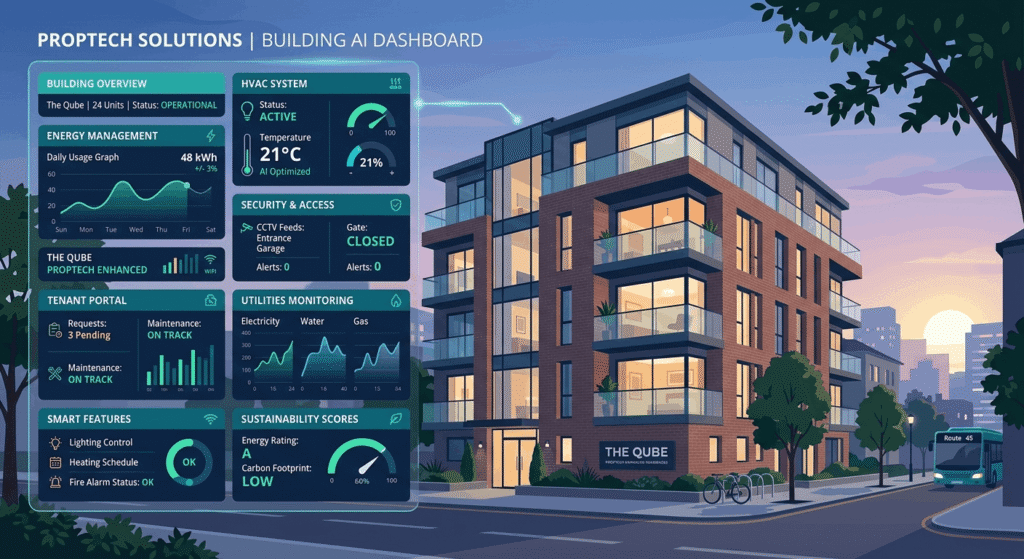
A critical factor in maximizing operational cost reduction lies in leveraging real-time building sensor data. These systems continuously feed temperature, humidity, and energy consumption metrics to AI property management platforms, enabling accurate budgeting, timely interventions, and extensive reporting. This foundation of constant, quality data supports predictive maintenance, regulatory compliance, and energy optimization, underpinning the financial benefits of automation.
Harnessing Building Sensor Data and Data Insights
Contemporary AI property management platforms take advantage of building sensor data to drive real-time improvements. These sensors can monitor everything from energy consumption to occupancy patterns and HVAC status. By feeding this live information into AI algorithms, property managers gain actionable data insights that were previously unattainable.

Predictive Maintenance AI
Predictive maintenance AI analyses patterns in building sensor data—like water usage or system temperature—to predict and prevent breakdowns before they disrupt operations. Platforms such as AppFolio Smart Maintenance and DrizzleX provide these capabilities, allowing UK operators to resolve issues proactively and align maintenance with regulatory requirements. Predictive maintenance AI not only reduces downtime and emergency repair costs but also helps futureproof asset investment.
Energy Optimization and Compliance
AI property management platforms utilize sensor data to detect energy waste, track compliance issues, and provide actionable recommendations. By addressing HVAC failures, identifying leaks, or optimizing energy consumption, operators can achieve operational cost reduction, remain aligned with UK safety codes, and meet ESG (Environmental, Social, Governance) objectives. These systems are especially valuable as UK property regulations, like PRS registration and ESG reporting, become more stringent.
Data-Driven Decision Making
The ability to extract deep data insights from real-time building metrics distinguishes AI property management. Portfolio managers use analytics to track performance, optimize budgets, monitor compliance, and anticipate tenant needs. Granular reporting is vital for efficient regulatory reporting under the UK GDPR and Renters’ Rights Bill.
The Role of Data Insights in Strategy
Superior data insights not only uncover operational bottlenecks but also highlight opportunities for revenue growth or improved tenant satisfaction. Effective use of building sensor data—and the ability to translate it into actionable property management decisions—is defining a new standard for industry leaders in the UK.
AI-Powered Solutions: Automated Rent Collection, Leasing Assistants, and Real Estate Chatbots
Specialized AI property management tools offer multifamily operators customizable, scalable solutions for their core challenges.
Automated Rent Collection
Systems like TenantCloud and Buildium automate every step of rent collection, from sending reminders to allocating payments and applying late fees. These platforms lift manual burdens and drive up payment compliance, delivering significant operational cost reduction while offering tenants a more streamlined, modern experience.
AI Leasing Assistant
With AI leasing assistants from platforms like Showdigs and AppFolio, agencies automate the process of responding to enquiries, qualifying leads, and scheduling property viewings. As a result, properties are let faster, conversion rates climb, and administrative workload for staff plummets.
Real Estate Chatbots
Real estate chatbots, such as those available via Visitt, enable round-the-clock tenant communication and support. These solutions address routine issues, field maintenance requests, and deliver relevant updates, reducing bottlenecks for staff and assuring tenants their concerns will be heard no matter the hour.
AI Document Processing
Re-Leased with Credia Extract uses AI to process and abstract lease documents automatically, substantially reducing the risk of legal non-compliance and saving hours per contract review. This approach sharply lowers error rates—a critical benefit for multifamily portfolios with frequent lease renewals.
Accounting Automation
AI-driven accounting tools, including Proper.AI and Clyr, automate expense coding, invoice tracking, and reporting. With enhanced transparency, compliance, and error reduction, finance teams can keep portfolios audit-ready and focus on more strategic analysis.
Integrating these solutions with major systems like Yardi and MRI delivers the greatest gains, keeping all data synchronized from tenant to back office.
Implementing Real Estate Chatbots for Enhanced Tenant Engagement
Using real estate chatbots as part of an AI property management strategy has proven effective for sustaining high levels of resident engagement and reducing missed issues. UK companies that combine chatbots with automated rent collection and predictive maintenance AI report measurable improvements in both satisfaction rates and operational KPIs.
How to Implement AI Automation in Property Management
A careful approach to implementing AI property management ensures success and smooth adoption. Here’s a recommended roadmap for UK multifamily operators:
- Identify areas where manual tasks are most time-consuming, such as automated rent collection, financial reporting, or handling tenant queries.
- Map current software infrastructure and data processes to identify required integrations and data flow issues.
- Define measurable objectives—like reducing manual admin hours by 30% or improving conversion rates by 20%.
- Research AI property management solutions, focusing on integration with your existing platforms.Evaluate providers such as AppFolio, TenantCloud, Proper.AI, Visitt, and DrizzleX.
- Integrate new tools with established property management systems, maintaining robust data security protocols.
- Train staff and onboard tenants, explaining changes and emphasizing the derived benefits such as faster response times and better transparency.
- Pilot the system in part of your portfolio, comparing KPIs like arrears, conversion rates, and hours saved against prior results.
- Expand and optimize, regularly collecting feedback and adapting processes to new requirements or opportunities.
Property managers seeking support with digital transformation or project planning can learn more on the Development or Contact Us pages.

AI Tools Comparison: UK Multifamily Property Management
Leading AI property management tools for UK multifamily portfolios are summarized below:
| Tool | Key Features | Pricing (Estimate) | UK Market/Support | Best For |
|---|---|---|---|---|
| [AppFolio](https://www.appfolio.com/) | Smart maintenance AI, leasing/chatbots, accounting | £5–£12/unit/mo+ | Yes (UK-enabled) | Full-suite operations |
| [Re-Leased/Credia Extract](https://www.re-leased.com/) | Lease abstraction, compliance, reporting | Custom, from ~£6/unit/mo | Yes | Compliance for large portfolios |
| [TenantCloud](https://www.tenantcloud.com/) | Automated rent, maintenance, comms, reports | Free–£30/mo | Yes | Small to medium portfolios |
| [Proper.AI](https://www.proper.ai/) | AI accounting, dashboards, expense processing | From £7/user/mo | Yes | Finance and back-office automation |
| [Showdigs](https://www.showdigs.com/) | AI leasing assistant, applicant screening, scheduling | From £8/unit/mo | Yes (UK integrations) | New lets/conversions |
| [DrizzleX](https://www.drizzlex.com/) | Energy/water metering, utility analytics | Custom | Yes | Utility optimization, ESG |
| [Visitt](https://www.visitt.io/) | Operations AI, real estate chatbots, amenity tools | From £1/unit/mo | Yes | Community/tenant experience |
| [Buildium](https://www.buildium.com/) | Rent collection, workflow automation, accounting | From £52/mo | Yes (UK options) | End-to-end for small and medium firms |
*Pricing may vary; confirm details and available features at purchase.*
AI vs. Traditional Property Management: What’s the Difference?
Comparing traditional property management to AI-enhanced operations reveals stark differences across core areas of business:
| Area | Traditional Property Management | AI-Driven Property Management |
|---|---|---|
| Manual Workload | High: manual calls, spreadsheets, emails | Low: reduces workload by 40%+ with AI |
| Cost Base | £34k+/admin plus errors and OT | £3–£6k/year for AI automation |
| Efficiency | Error-prone, slow, reactive | Fast, predictive, self-correcting |
| Customer Service | Standard hours, missed requests | 24/7 real estate chatbots and AI support |
| Compliance | Manual, paperwork-heavy | Automated, real-time monitoring |
| Data/Insights | Disconnected, historical | Live dashboards and analysis |
| Scalability | Staff-bound, slow to expand | Scales instantly with portfolio size |
| Conversion Rates | Slower, missed leads | Up to 30% higher due to fast response |
| Maintenance | Reactive, expensive call-outs | Predictive maintenance AI |
| Tenant Experience | Slow and sometimes unresponsive | Rapid, frictionless processes |
AI property management delivers improved efficiency, reduced errors, and greater tenant satisfaction, helping UK operators excel as industry standards rise.
Common Mistakes When Adopting AI in Property Management
Some pitfalls can mute the impact of AI property management if not addressed from the outset.
Incomplete Data Integration
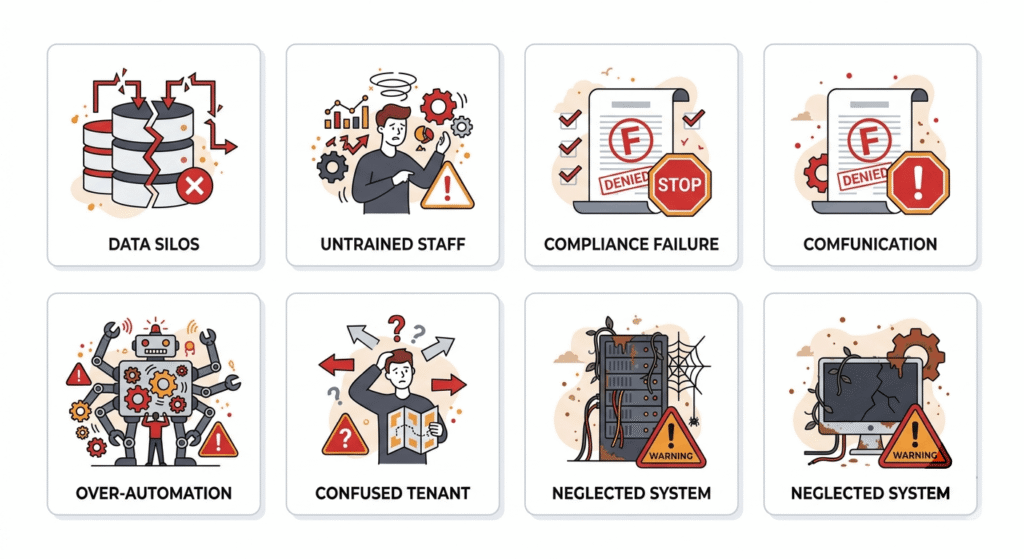
Failure to connect new AI solutions with foundational software—like Yardi, MRI, or Re-Leased—causes data silos and inefficiency. Always ensure robust integration between AI tools and existing property management platforms.
Underinvesting in Staff Training
Not providing adequate staff training breeds frustration and poor process adoption. Facilitate interactive workshops and ongoing support to ensure teams are equipped and confident using new tools.
Compliance Shortfalls
Neglecting regulations such as GDPR or the Renters’ Rights Bill exposes operators to penalties. Partner with AI property management vendors who offer proven, UK-compliant security and record-keeping workflows.
Ignoring the Human Touch
Over-reliance on automation can reduce tenant satisfaction if it erodes meaningful communication. Balance AI-powered processes, like real estate chatbots, with proactive, personal engagement to cultivate community trust.
Poor Communication With Tenants
Rolling out features such as automated rent collection or chatbot-driven support without clear explanations causes confusion or mistrust. Regular updates outlining changes, their benefits, and security provisions are essential for a smooth transition.
Treating AI as a “Set-and-Forget” Solution
AI property management requires periodic review and ongoing optimization. Regularly check in with your technology partners and internal teams to adapt processes as regulations and market needs change.
Preventing Mistakes: Leveraging Internal Resources
Agencies that succeed often use resources such as the Design and MVP teams to pilot and troubleshoot new workflows before company-wide rollout.
AI Automation in the UK: Legislation, Compliance and Adoption Trends
AI automation for property management in the UK operates within a complex legal and business environment.
GDPR, Renters’ Rights Bill, and Compliance
AI property management systems that handle tenant data must adhere to UK GDPR protocols for data handling, security, and access. With the Renters’ Rights Bill set for full effect in late 2025, automated compliance becomes more crucial. AI platforms like Re-Leased are now essential to tracking documentation, automating reporting, and supporting PRS registration for landlords.
Rapid AI Adoption and Sector Trends
The scale of AI adoption in UK property management is accelerating. In 2025, Homesearch HAILO, an AI platform, onboarded more than 4,000 agency branches within two weeks—a sign of rapid sector-wide acceptance. Surveys confirm that nearly 80% of UK property developers and managers are actively investing in AI tools, while forecasts place annual market growth between 16% and 22% through 2032.
The Evolving Tech Stack
UK operators increasingly depend on advanced systems combining building sensor data, predictive maintenance AI, and real estate chatbots. AI is now central to remaining compliant, competitive, and responsive amid tightening regulation and growing operational complexity. Successful property management firms now see their AI platforms as a “digital workforce” extending their team’s reach and resilience.
FAQs
1. How much manual work can AI really reduce for my portfolio?
AI property management typically reduces manual workloads by 20% to 40%. The exact savings depend on the extent of automation and which processes are targeted. The most significant reductions are reported where automated rent collection, predictive maintenance AI, and tenant communications are fully integrated.
2. Are AI chatbots and leasing assistants secure and GDPR-compliant?
Reputable AI chatbots and leasing assistants deployed in UK property management are engineered for GDPR compliance. They use secure data processing, encrypted communications, and comprehensive audit logs. Always verify your vendor’s credentials and clarify security protocols before going live.
3. What types of data are needed for predictive maintenance AI?
Predictive maintenance AI depends on building sensor data streams—covering temperature, humidity, HVAC operation, power, and water usage—along with maintenance history logs. Rich, accurate data empowers the AI to recommend timely fixes, minimize downtime, and support operational cost reduction.
4. Can AI improve rent collection and reduce arrears?
Absolutely. Automated rent collection systems use reminders and recurring payments to minimize late payments and lower arrears. UK property managers report improved on-time rates and a dramatic reduction in errors—especially when AI is integrated with existing payment and accounting systems.
5. How do I choose the right AI property management tool?
Evaluate each AI property management tool’s relevance for the UK market, ease of integration, vendor support, and proven results. Conduct pilots or request demos before committing. Internal teams can research options independently or seek guidance through the Home or Our Story sections for background and case studies.
Conclusion
AI automation for property management is already transforming UK multifamily portfolios, consistently driving up to 40% manual work reduction and substantial operational cost reduction. Whether through automated rent collection, leveraging deep data insights from building sensor data, or deploying real estate chatbots, UK operators that adopt AI property management position themselves for durable growth, regulatory alignment, and a competitive edge in resident experience.