


Quick Answer Box: The custom website vs WordPress decision comes down to how much control you need against how fast you need to launch. WordPress runs 40.7% of all websites and can put a business online in weeks for under $5,000. A custom build costs more upfront but strips out plugin dependencies, which caused 91% of WordPress vulnerabilities disclosed in 2025.
Custom Website vs WordPress: Which Is Better for Your Business?
Most owners frame the custom website vs WordPress choice as a budget question. It isn’t. It’s a question about who maintains your site eighteen months from now, and how many pieces of other people’s code you’re willing to be responsible for.
What to Look For When Comparing a Custom Website vs WordPress
Five things separate the two options: build cost, launch speed, ongoing maintenance load, performance ceiling, and how much of your site depends on third party code. Rank those five in order of importance to your business and the answer usually appears without a feature-by-feature comparison.
A five-page brochure site for a local service company has almost nothing in common with a 4,000-SKU catalog or a members portal. Match the platform to the actual job. Not to what a competitor down the street happens to use.
How Do Custom Website Pricing and WordPress Costs Compare?
Custom website pricing splits along who does the work, not which software you pick. A freelancer building on WordPress typically charges $500 to $5,000 one time. Agency-built custom sites run $5,000 to $30,000 and up, take one to three months, and carry $50 to $200 a month in maintenance.
| Factor | WordPress build | Custom website |
|---|---|---|
| Typical build cost | $500 to $5,000 with a freelancer | $5,000 to $30,000+ with an agency |
| Launch timeline | 2 to 6 weeks | 1 to 3 months |
| Monthly upkeep | $50 to $200 plus plugin licenses | $50 to $200, few license fees |
| Core Web Vitals pass rate | 46.28% of WordPress origins pass | Determined by your own code and hosting |
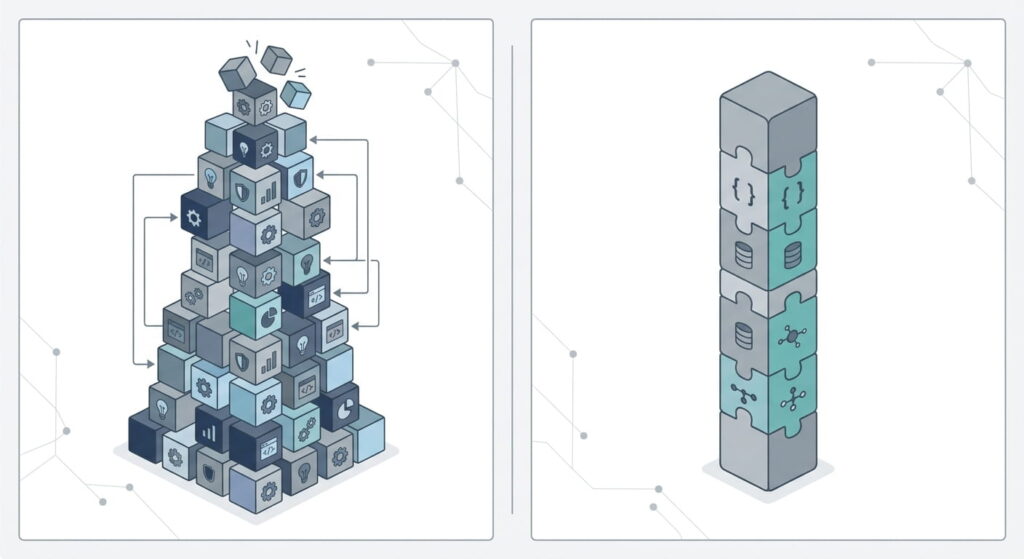
| Third party dependency | 70,000+ plugins, each one a surface | Only the code your team wrote |
That maintenance line is where budgets quietly break. Plugin licenses renew annually, and a stack of fifteen premium plugins can add $900 a year on its own. Our website design cost breakdown walks through the full first-year math.
Why Should I Choose WordPress Over Other Website Builders?
WordPress holds 58.9% of the market among sites with a known CMS, and the reason is ownership. You can export your database, move hosts, and keep your content. Closed builders like Wix and Squarespace don’t offer that exit. Your site lives where they say it lives.
The official WordPress plugin directory lists over 70,000 free plugins, which means booking systems, payment gateways and CRM connections already exist. You’re assembling, not inventing. For a business that needs to be live before the quarter ends, that speed is worth real money.
Why Is a Custom Website the Best Option for Some Businesses?
The clearest reason why a custom website is the best fit for some companies is workflow. Quoting engines, multi-location inventory, gated client dashboards, ERP syncs: these get built as plugin duct tape on WordPress, and every added layer brings fragility. Custom code does one job and does it directly.
There’s a real tradeoff. Custom builds lose their cost advantage below roughly $8,000 of scope, because you’re paying to rebuild features WordPress ships for free. Below that line, a WordPress build almost always wins on economics.
Which Option Delivers Better Website Scalability?
Website scalability is less about the platform and more about the database and hosting under it. WordPress runs sites with millions of monthly visitors, but it needs object caching, a CDN, and query discipline to get there. Custom applications can be architected for that load from day one.
Traffic isn’t usually what breaks a growing site. Editorial volume is. Once a WordPress install passes roughly 10,000 posts with heavy taxonomy filtering, unoptimized queries start dragging admin pages to a crawl, and the fix is developer work either way.
Does a Custom Build or WordPress Produce a More SEO Friendly Website?
Both can rank. The gap shows in speed. Google’s Core Web Vitals thresholds call for LCP under 2.5 seconds, INP under 200 milliseconds, and CLS under 0.1 at the 75th percentile. WordPress origins pass all three only 46.28% of the time, against 55.9% for the web overall.
Look closer and the diagnosis is specific. WordPress passes INP at 85.89%. The failure is LCP, meaning bloated themes, unoptimized hero images and render-blocking plugin CSS. An SEO friendly website on WordPress is achievable, but you get there by cutting weight, not by adding another optimization plugin.
Is Custom WordPress Development the Smarter Middle Ground?
Custom WordPress development keeps the editor your team already knows while removing the dependency problem. You build a bespoke theme, write the two or three functions you actually need as small plugins, and skip the page builder entirely. Most agencies now recommend this over both extremes.
The security math explains why. Patchstack’s State of WordPress Security in 2026 recorded 11,334 new vulnerabilities in 2025, up 42% year over year. Plugins accounted for 91% of them. WordPress core accounted for six.
What Custom WordPress Website Design Changes in Practice
Custom WordPress website design cuts your plugin count from thirty to under ten, which removes most of that attack surface outright. Timing matters here: the weighted median gap between public disclosure and active exploitation is now five hours, and 46% of 2025’s vulnerabilities had no patch available at disclosure. Hosting firewalls blocked just 12% of attacks in Patchstack’s testing.
Custom WordPress website development for businesses handling payments or client data is often the honest recommendation. Full custom for the application layer, WordPress for content. See our custom WordPress development services for how that split usually gets scoped.
Frequently Asked Questions
1. Is a custom website better than WordPress for SEO?
Not inherently. Both output the same HTML, schema and meta tags that search engines read. Custom builds win on measurable page speed, since WordPress origins pass Core Web Vitals 46.28% of the time versus 55.9% across the web. A lean WordPress build closes most of that gap.
2. How much does a custom website cost compared to WordPress?
Custom website pricing typically starts at $5,000 and reaches $30,000 or more for agency work, against $500 to $5,000 for a freelance WordPress build. Both carry $50 to $200 monthly maintenance. The bigger long-term variable is premium plugin renewals, which custom sites avoid.
3. Can WordPress handle a large business website?
Yes. WordPress runs 40.7% of all websites, including major publishers and enterprise sites. Reaching that scale requires managed hosting, object caching, a CDN and clean database queries. Without those, website scalability problems appear well before your traffic does.
4. Is WordPress secure enough for a business website?
WordPress core is solid. The risk sits in what you install:
- Plugins caused 91% of the 11,334 vulnerabilities disclosed in 2025
- Only six vulnerabilities were found in WordPress core
- Median time from disclosure to exploitation is five hours
- 46% of vulnerabilities had no patch ready at disclosure
Fewer plugins, faster patching, and a virtual patching service handle most of this.
5. Should I switch from WordPress to a custom website?
Switch when WordPress is actively blocking you, not when it feels dated. Clear signals include plugin conflicts breaking checkout, LCP stuck above 2.5 seconds after optimization, or a workflow no plugin supports. Otherwise a rebuilt custom theme costs far less than a full migration.
Conclusion
The custom website vs WordPress answer depends on scope, not preference. Under $8,000 with standard functionality, WordPress wins on cost and speed to launch. Above that, with custom workflows or compliance requirements, a custom build pays for itself in maintenance avoided. For most growing businesses, custom WordPress development lands in between and delivers the practical benefits of both.