


Quick Answer Box: MVP case studies are records of how real startups tested an idea with the smallest possible version of a product. The five below, from Airbnb, Dropbox, Zappos, Buffer and Groupon, all proved demand before the founders wrote serious code. Each one took weeks, not quarters.
What are MVP case studies?
MVP case studies are documented accounts of how real startups tested a product idea using the smallest thing they could ship. They record what the founders built, what they faked, what they measured, and what happened next. Founders read them to copy validated tactics instead of guessing at what a first version should include.
TL;DR
- Airbnb’s first product was three air mattresses and a one-page site charging $80 a night, in the fall of 2007.
- Dropbox had no public product when its 2008 demo video pushed the beta waiting list from 5,000 people to 75,000 in about a day.
- Zappos sold shoes it did not own, photographing stock in local stores. Amazon bought it in 2009 for about $1.2 billion.
- Buffer launched on two web pages. Joel Gascoigne had a paying customer four days later.
Why do MVP case studies beat MVP frameworks?
Frameworks tell you an MVP should be small. Case studies tell you exactly how small, and what the founder gave up to get there. Most first-time founders cut features and still ship something that takes six months.
None of the five founders below built a smaller version of the final product. They built a different thing entirely, usually manual, to answer one question: will anyone pay?
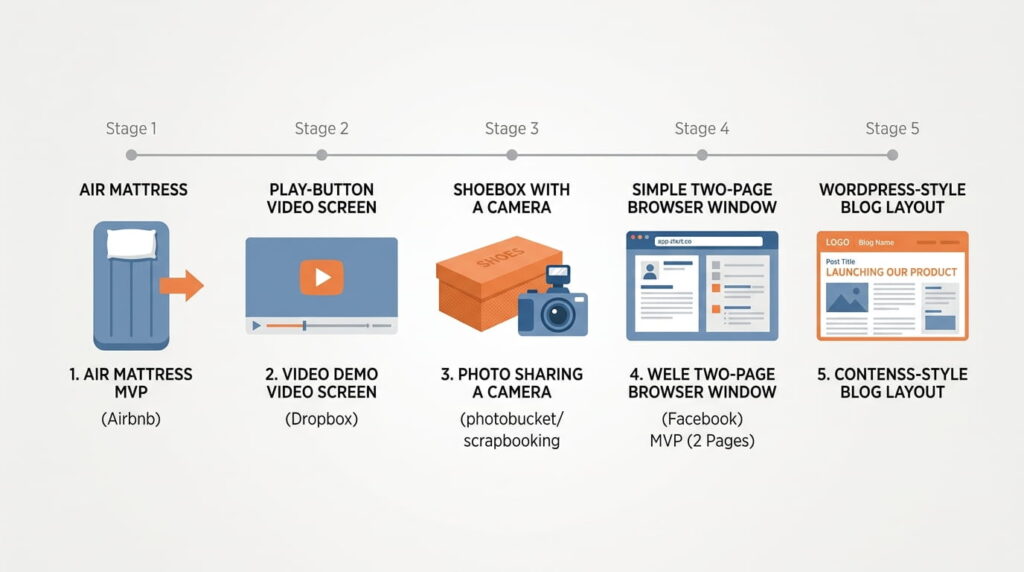
5 real-world MVP case studies every founder should read
Each of these MVP case studies covers what the founders shipped, how long it took, and the signal they watched. Read them for the mechanics. The billion-dollar ending is the least useful part of any mvp story, since it came years after the decisions that counted.
1. Airbnb: three air mattresses and a one-page site
In the fall of 2007, Brian Chesky and Joe Gebbia could not make rent in San Francisco. A large design conference had booked out the city’s hotels. They put three air mattresses on their floor, built a site called airbedandbreakfast.com, and charged $80 a night.
Three strangers booked. That was the entire test.
The signal was not revenue. It was that strangers would sleep on someone’s floor and pay for it. Two years later, Airbnb doubled New York revenue by renting a camera and photographing listings, which showed the bottleneck was photos, not supply.
2. Dropbox: a demo video for a product that did not exist
Drew Houston faced a problem no landing page could solve. File syncing is invisible, so nobody could tell from a screenshot whether it worked, and building it meant months of file-system work first.
In 2008 he recorded a three-minute screencast of a product that was not publicly available, stuffed with in-jokes aimed at the Hacker News and Digg crowd. The beta waiting list went from around 5,000 people to 75,000 in a day. Dropbox had demand data before a launch.
3. Zappos: a shoe store with no shoes
Nick Swinmurn founded ShoeSite.com in 1999, later renamed Zappos. No inventory, no supplier deals. His test was almost embarrassingly manual: photograph stock in local shoe stores, post the photos online, and when an order came in, go back, buy the pair at retail and ship it.
He lost money on most sales, which was fine. The question was whether Americans would buy shoes they could not try on. Gross sales hit $1.6 million across 1999 and 2000. By 2008, Zappos was doing $1 billion a year.
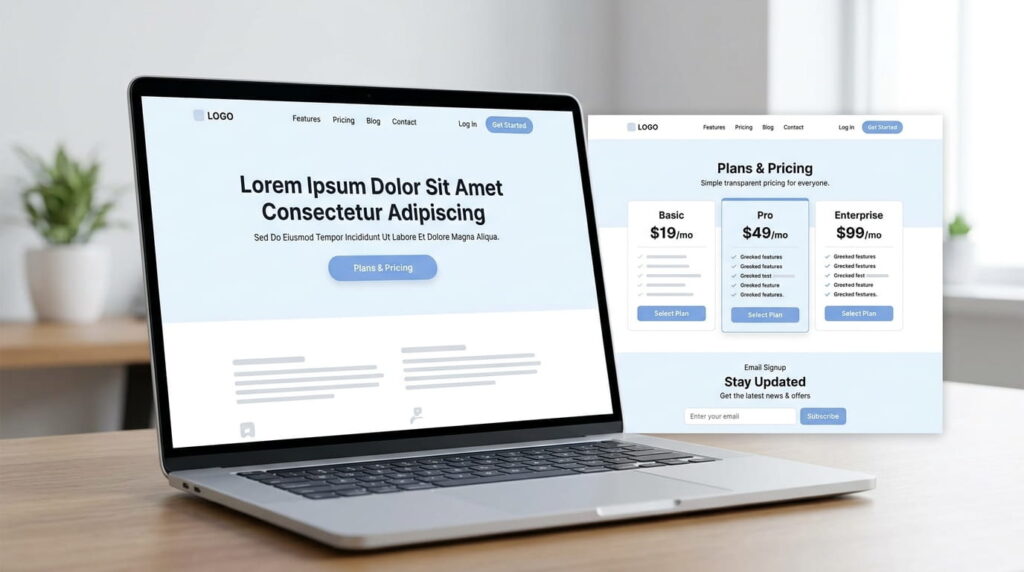
4. Buffer: a two-page mvp example that charged money first
Joel Gascoigne’s version is the cheapest test here. Page one described the idea and had a “plans and pricing” button. Page two admitted the product did not exist yet and asked for an email address.
People clicked. So he added a middle page with real pricing tiers and watched whether they still clicked, this time on a paid plan. Some did. Only then did he start building, over seven weeks of evenings and weekends. Buffer launched on November 30, 2010, and had a paying customer four days later.
5. Groupon: a WordPress blog and PDF coupons
Andrew Mason’s first company, The Point, was a collective-action platform that was not working. Users kept organizing around one thing: group discounts. In November 2008 he pointed the company at that.
The first version of Groupon was a WordPress blog. Coupons came out of FileMaker, a desktop database app, emailed by a script on a local machine. The first deal was two-for-one pizza at Motel Bar, on the ground floor of their own building. Groupon went public on Nasdaq in November 2011.
What MVP strategy patterns repeat across every mvp story?
Three patterns show up in all five accounts. Each founder replaced software with human labor, tested willingness to pay rather than interest, and shipped something slightly embarrassing.
The labor substitution is the most copyable. Zappos had a person buying shoes at retail. Groupon had a script on a laptop. Neither scaled, and neither needed to.
Interest, by contrast, is free to give. Buffer’s pricing page worked because clicking a paid tier costs something emotionally, before any card is entered. Most product MVP example write-ups gloss over that.
Notice what nobody did. Nobody ran a survey, and nobody wrote the roadmap that usually opens a go-to-market plan.
How do you run market research before building an MVP for startups?
Thirty days is enough for a real test if you refuse to write production code in the first two weeks. Market research here means talking to buyers and watching behavior, not reading industry reports. The sequence below mirrors what Gascoigne and Swinmurn did.
- Days 1 to 5: interview 15 people with the problem. Ask what they did last time it happened, never what they would do.
- Days 6 to 10: name the riskiest assumption. Usually it is “they will pay,” not “we can build it.”
- Days 11 to 15: design the cheapest test of that assumption. A video, a pricing page, a spreadsheet behind a form.
- Days 16 to 22: run it in front of 100 real buyers.
- Days 23 to 30: decide. Build, change the test, or drop the idea.
Which minimum viable product examples match your idea?
Pick the MVP type by what you are unsure about, not by what is easiest to build. If you doubt demand, fake the product. If you doubt feasibility, build a thin slice. These minimum viable product examples map to the situation each one suits.
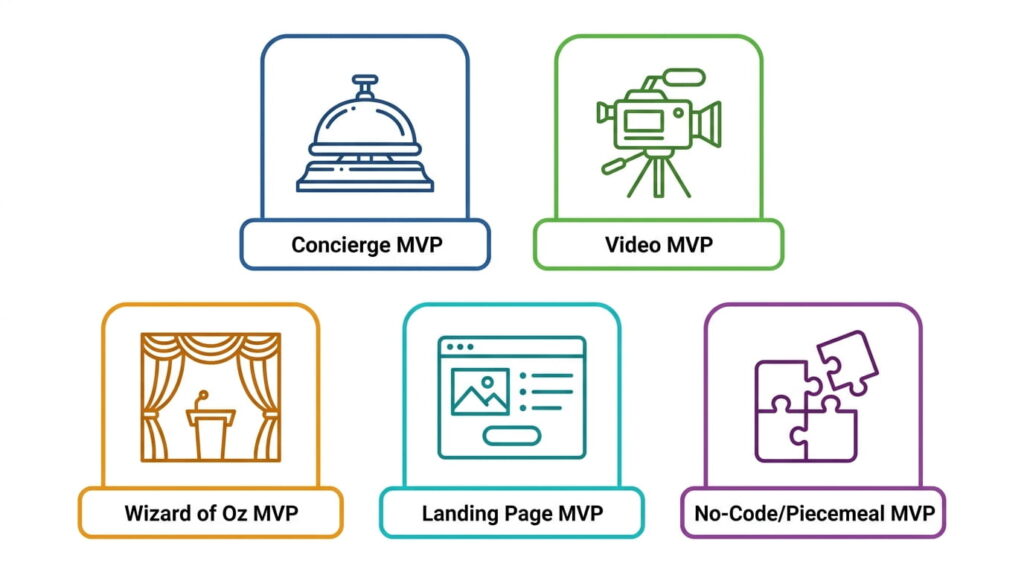
| MVP type | Real example | Best when | Typical build time |
|---|---|---|---|
| Concierge | Airbnb, 2007 | You can serve early users by hand | 1 to 2 weeks |
| Demo video | Dropbox, 2008 | Value is invisible in a screenshot | 3 to 10 days |
| Wizard of Oz | Zappos, 1999 | Buyers must not see the manual backend | 2 to 4 weeks |
| Landing page | Buffer, 2010 | Willingness to pay is the open question | 2 to 5 days |
| No-code stack | Groupon, 2008 | Existing tools can fake the workflow | 1 to 3 weeks |
Common mistakes to avoid with MVPs
The most expensive mistake is building a small version of the final product instead of a test. A stripped-down app still takes months and answers nothing you could not learn in two weeks.
Second: counting signups when you needed payments. Free interest is not a market.
Third: shipping to an audience that is not your buyer. Houston posted to Hacker News because developers were the target, not because traffic was cheap. A viral post to the wrong crowd predicts nothing.
Frequently Asked Questions
1. What is a minimum viable product?
A minimum viable product is the smallest version of an idea that produces reliable learning about whether people want it. It does not have to be software. In several of the MVP case studies above it was a video, a photograph, or manual labor.
2. How long should it take to build an MVP?
Two to eight weeks for most software ideas. Buffer’s landing page took days. Zappos needed a few weeks of store visits before orders arrived. Past three months, you are building the product rather than a test of it.
3. How much does an MVP cost to build?
A few hundred dollars for a landing page test, $30,000 or more for a working prototype built by a developer. The five MVP case studies here cost almost nothing because the founders traded their own time for engineering.
4. Do I need to write code to launch an MVP?
Often no. Groupon ran on WordPress and a desktop database in 2008. The same job today takes a form builder and an email tool. Code becomes necessary once manual delivery breaks under volume.
5. How do I know if my MVP succeeded?
Judge it on behavior, not compliments. Watch for:
- People paying, or entering payment details, without a discount
- Users returning unprompted within seven days
- Requests from people you never contacted
- Tolerance for an obviously rough experience
Conclusion
The thread running through these MVP case studies is a refusal to build before knowing. Airbnb tested with mattresses, Dropbox with a video, Zappos with photographs, Buffer with two pages, Groupon with a blog. Each learned something true within weeks. Pick the test that matches your riskiest assumption, then let the answer decide what you build. Our startup validation checklist has the scripts.