

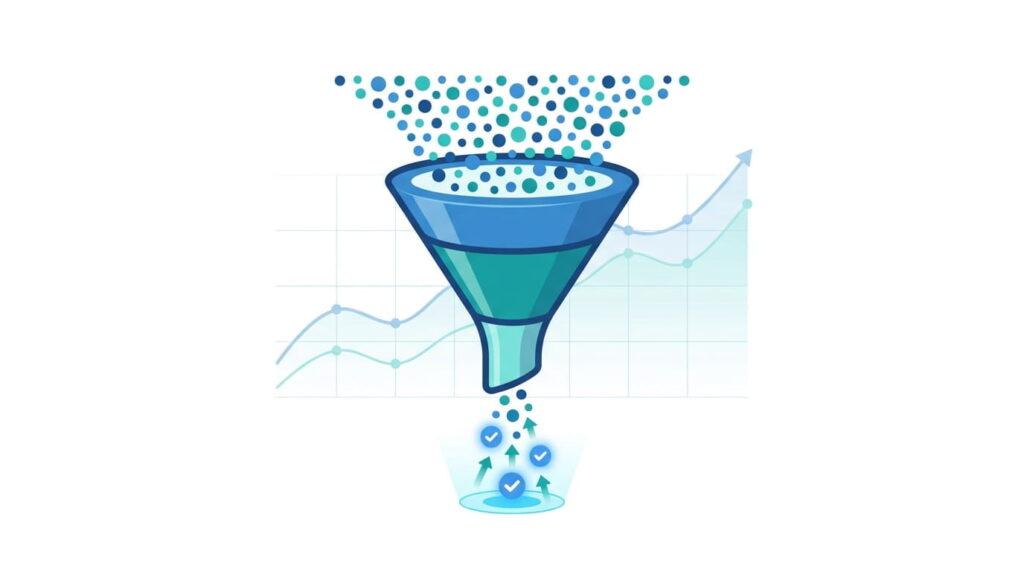
Quick Answer: Conversion rate optimisation is the practice of raising the percentage of visitors who complete an action on your site, such as buying, booking, or sending a form. CRO works by studying how people behave on your pages, forming a hypothesis about what stops them, testing that change against the original, and keeping only what wins.
What is conversion rate optimisation?
Conversion rate optimisation, spelled optimization in US English, is the systematic process of getting more conversions out of traffic you already have. Instead of buying more visitors, you remove the reasons the current ones leave. The gap is wide: across all industries, roughly 1.7% of website visitors convert, so about 98 in every 100 arrive and do nothing. COAX Software
How to calculate your website conversion rate
Divide conversions by total visitors, then multiply by 100. Thirty form submissions from 1,000 sessions is a 3% website conversion rate. The number on its own means little without a peer group. Landing pages average around 2.35%, while the top quarter clear 5.31%. Global ecommerce sits between 1.4% and 3.0% depending on which dataset you trust, and B2B sites land between 2.23% and 4.31%. Mobile converts at roughly half the desktop rate, near 2.0% against 4.1%, which is why device-level reporting matters more than a single sitewide figure. PopupSmart + 3
What CRO in marketing actually covers
CRO in marketing picks up where acquisition ends. Search earns the visit; conversion work decides how many of those visitors act once they land. In practice that means landing pages, forms, checkout steps, pricing tables, and the copy on your product pages. Some of it is words. Plenty of it is how the site is built. What it never means is dark patterns: fake countdown timers and buried unsubscribe links move this quarter’s numbers and cost you next quarter’s refunds. Aureate Labs
How does conversion rate optimisation work?
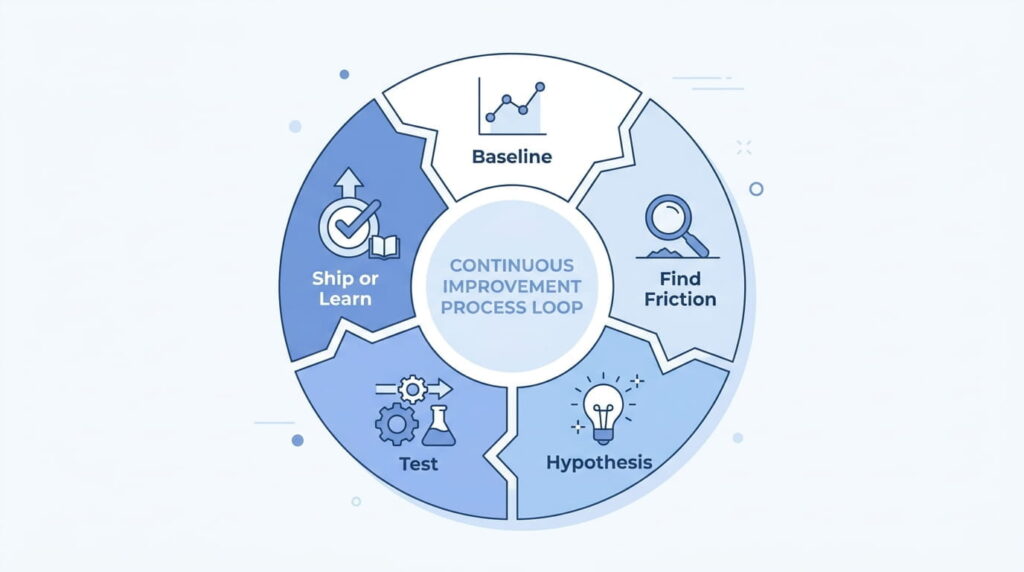
Conversion rate optimisation works as a loop, not a one-time redesign. You collect behavioral data, pick the single biggest leak, write a hypothesis, run a controlled experiment, then either ship the winner or record the loss and move to the next idea. Most teams skip the research and go straight to guessing, which is why most tests fail.
- Set your baseline. Configure conversion tracking so you can see the current rate by page, by device, and by traffic source before you touch anything.
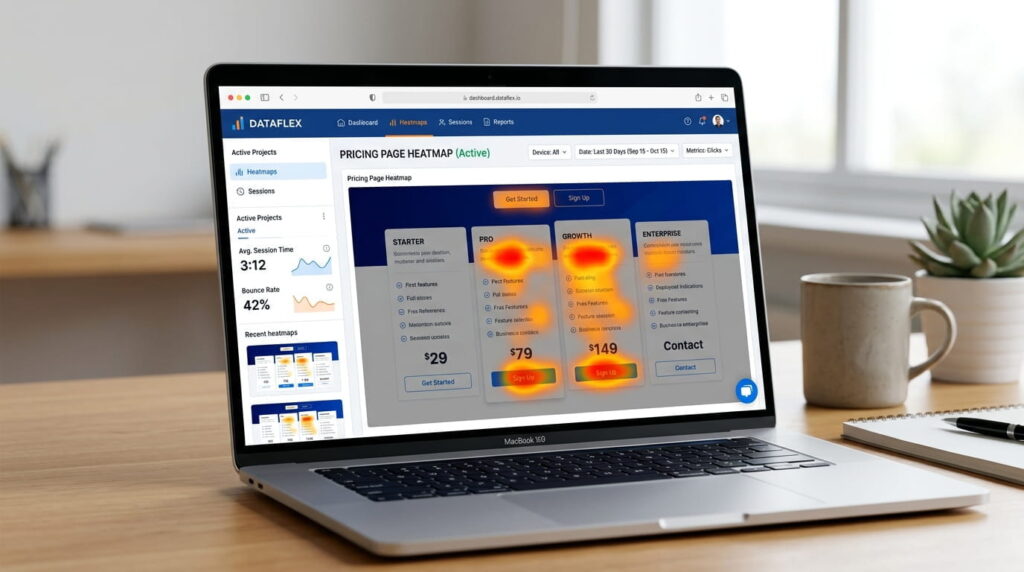
- Find the friction. Heatmaps, session recordings, and funnel reports show where people stall, and a free tool like Microsoft Clarity will record every session from day one. A three-question on-page survey usually tells you why.
- Write one testable hypothesis. Cutting a quote form from seven fields to three will raise submissions is a hypothesis. The form feels long is not.
- Run the test properly. The working standard is 95% significance and at least 100 conversions per variation, held for one to two complete business cycles, usually two to four weeks. Atticus LiCro Metrics
- Ship it or bank the learning. A losing test still tells you something real about your buyers, and that insight carries into the next experiment.
Patience is the part teams get wrong. Tests stopped under 14 days carry a false positive rate near 61%, so an early lift often evaporates once the weekend and payday traffic arrives. Calibrate your expectations too: only about one in five experiments reaches statistical significance, and the median winning lift is close to 6%, not the doubling you see in case studies. YouTube + 2
Which parts of the customer journey should you optimise first?
Map the customer journey from the ad click or search result through to the confirmation page, then measure the drop at every step. Optimise where the money leaks, not where opinion is loudest. A checkout that loses most of its carts deserves more attention than a homepage headline nobody disputes.
CTA optimisation
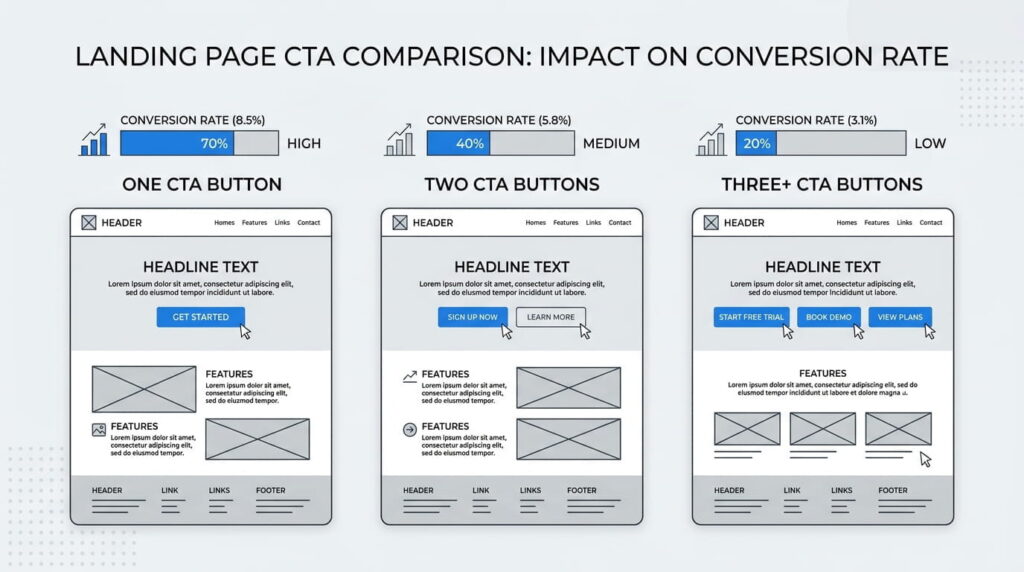
Start with count, not color. Across 18,639 landing pages, Unbounce found single-CTA pages converting near 13.5%, two-CTA pages at 11.9%, and pages with three or more at 10.5%. Every extra choice is a decision the visitor never asked to make. Copy comes next: Michael Aagaard’s Unbounce test swapped “your” for “my” in the button and lifted clicks by 90%, with later replications typically landing between 10% and 40%. YougovApexure
Website usability and page speed
Website usability failures are rarely dramatic. A shipping cost that appears at step four, a phone field that rejects a valid format, a submit button sitting below the fold on a six-inch screen. This is where UI and UX design decisions stop being cosmetic. Speed is the one usability factor with a hard number attached: Deloitte and Google measured a 0.1-second mobile improvement producing 8.4% higher retail conversions and 9.2% higher average order value across 37 brands, and Rakuten 24 reported 33.13% more conversions after fixing Core Web Vitals. Aim for LCP under 2.5 seconds, INP under 200 milliseconds, and CLS under 0.1. KISSmetrics + 2
CRO content that answers the real objection
CRO content is not more blog posts. It’s the specific reassurance a hesitant buyer needs at the exact moment of hesitation: what happens after the demo call, whether returns are free, who else in their industry already bought. Pull those objections from sales calls and support tickets, then answer them on the page where people abandon. Our RevSquared AI website build followed that order deliberately.
Which CRO tools do you actually need?
Most programs run on four types of CRO tools: analytics for the what, behavior tools for the why, an experimentation platform to test the fix, and a survey tool for direct feedback. You don’t need all four on day one. Start free, prove a win, then pay for what your traffic volume justifies.
| Tool | What it does | Cost |
|---|---|---|
| Microsoft Clarity | Heatmaps, session recordings, rage-click detection | Free, no session or pageview limits GOSH Digital |
| Google Analytics 4 | Conversion tracking, funnel and drop-off reports | Free UpGrowth |
| Hotjar | Recordings plus on-page surveys and feedback widgets | Free tier, paid plans above it |
| VWO | A/B and multivariate testing with a visual editor | Roughly $300 to $700 a month Convertify |
| Optimizely | Server-side experimentation and feature flags | Enterprise contracts, $40,000 a year and up Convertify |
Two things worth knowing before you shop. Google Optimize was discontinued in 2023, so any guide still recommending it is stale. And Hotjar now sits inside Contentsquare, which reshuffled its free tier and packaging. GOSH DigitalHotjar
Frequently Asked Questions
1. What is CRO in simple terms?
CRO stands for conversion rate optimisation. It’s the work of turning a bigger share of your existing visitors into customers by removing friction and testing changes, instead of paying for more traffic. In a business-roles context CRO can also mean Chief Revenue Officer, which is unrelated to the marketing practice. Aureate Labs
2. How long does CRO take to show results?
Plan on 90 days before the numbers mean much. A single test needs two to four weeks to reach a trustworthy result, and one agency dataset covering 90+ ecommerce brands puts the median test duration at 42 days. Technical fixes like page speed can pay off faster. Compounding gains take quarters. ConversionTeam
3. Is conversion rate optimisation part of SEO?
No, though they feed each other. SEO earns more visitors from search; CRO converts the visitors either search or ads deliver. Better usability, faster pages, and clearer answers help both. As AI Overviews absorb more informational clicks, impressions rise while click-through rates fall, making every earned visit worth more. Aureate LabsCOAX Software
4. What counts as a good website conversion rate?
It depends on your model, traffic source, and device mix. Useful reference points:
- Ecommerce: 2.5% to 3% is typical for established stores Propel Commerce
- B2B lead generation: 2% to 5% for form submissions Knock-ai
- Dedicated lead-gen landing pages: around 11.9% Mida-app
- Mobile: expect roughly half your desktop rate
- Email traffic: your highest-converting source at 4% to 5.3% Propel Commerce
5. How much does CRO cost?
Agency retainers commonly run $3,000 to $9,000 a month, specialist firms charge more, and companies spend close to $2,000 a month on tooling. A small site can start at zero with free analytics and heatmaps. The honest test is whether the lift outpaces what the program costs. Ask us what your traffic can support. Leadpages
Conclusion
Conversion rate optimisation is not a redesign, a checklist, or a one-week sprint. It’s a habit: watch what real visitors do, fix the largest leak, test the fix honestly, then do it again next month. Businesses that compound small wins quarter after quarter end up paying far less for every customer than competitors still buying their way out of a leaky funnel.