

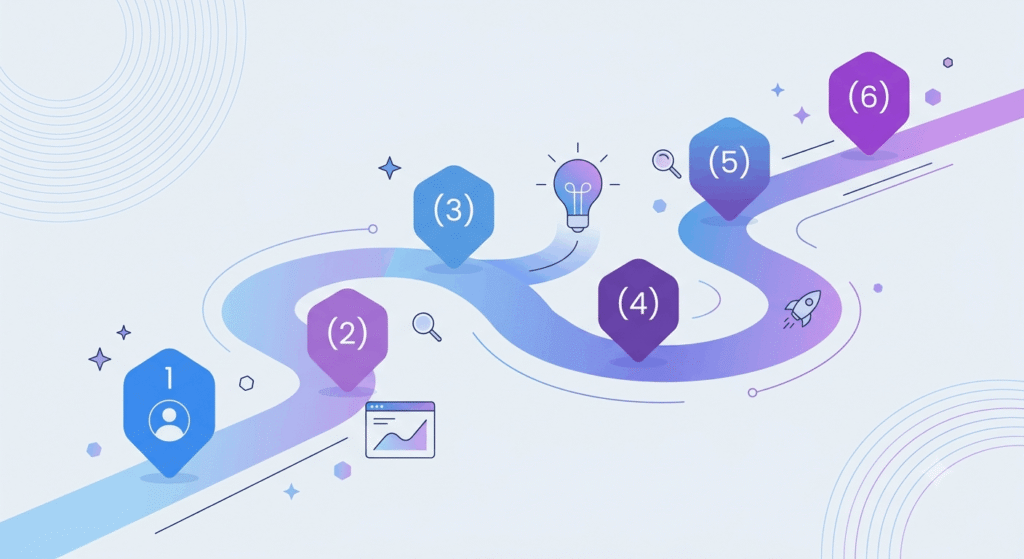
Quick Answer Box: The MVP development process is the sequence a team follows to turn an idea into a small, working product real users can try. Six steps cover it: validate the problem, scope one core loop, prototype, build, launch to a narrow audience, then decide from usage data whether to continue.
What is the MVP development process?
The MVP development process is a repeatable sequence for taking a product idea to a live release that real customers use. It runs from problem validation through scoping, design, build, launch, and measurement. The output that matters is evidence about demand, arriving in weeks instead of quarters.
TL;DR
- CB Insights reviewed 431 VC-backed shutdowns since 2023 and found 43% cited poor product-market fit. Those companies had raised $17.5 billion between them.
- Pendo’s study of 615 product subscriptions found 80% of features are rarely or never used.
- A realistic US timeline is 8 to 16 weeks. A launchable MVP from a US agency usually runs $50,000 to $120,000.
- Write your kill criteria before launch, not after.
Why do most startups fail before a line of code is written?
Because the decision that kills them happens at the whiteboard. CB Insights analyzed 431 venture-backed companies that shut down after 2023 and found 43% pointed to poor product-market fit. Running out of capital showed up in 70% of cases, but CB Insights calls that the ending, not the cause.
You will see an older figure quoted everywhere: 42% of startups fail from no market need. That came from roughly 110 post-mortems collected between 2014 and 2021. The 2024 update has four times the sample. Those 431 companies raised a median of $11 million each before dying, so money was not the missing ingredient.
How much user research do you need before you build an MVP?
Less than founders fear, more than they usually do. Jakob Nielsen’s work at Nielsen Norman Group put the number at five participants for qualitative usability testing, on the argument that five people surface around 85% of the problems in a given design. Customer discovery interviews are a different exercise and need more.
Nielsen’s caveat matters. The five-user rule holds for one group of comparable users. If your product serves two distinct groups, buyers and admins say, budget three to five people per group. Run the sessions in rounds. Five, fix, five again beats one round of fifteen.
Maze’s breakdown of sample sizes by research method is a useful reference when you are deciding who to recruit. Record the exact words people use to describe the problem.
How long does an MVP take to build, and what does it cost in the US?
Eight to sixteen weeks is the honest range for most US teams, from kickoff to something users can touch. Simple builds with three to five features land at six to eight weeks. Regulated products in health or fintech add four to eight weeks for audit logging, encryption, and vendor agreements.
Agencies now advertise AI-compressed timelines of 40% to 60%. Treat that carefully. METR’s randomized trial in July 2025 put 16 experienced developers through 246 real tasks and measured them 19% slower with AI assistance, while those same developers believed they had gone 20% faster. METR’s follow-up a year later flipped to an 18% speedup, and McKinsey found 46% savings on routine work but under 10% on complex work. The build phase was never where MVP software development went wrong anyway.
How to build an MVP in 6 steps, from idea to launch
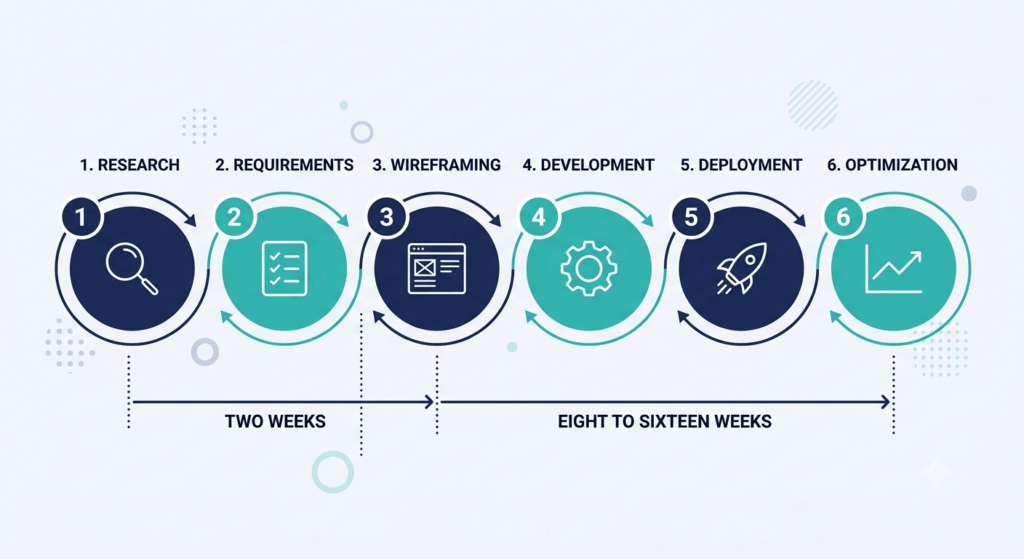
Each step ends with a decision you write down somewhere your team can see it. Run them in order. Steps one and two take roughly two weeks combined and save far more time than they cost, because scope gets cut there instead of in month three when the budget is already committed.
Step 1: Name the assumption that has to be true
Write one sentence: who has the problem, how they solve it today, and what they pay for that workaround. Then talk to 15 to 30 people in that group. Ask about their last attempt to solve it, never about whether they would use your product. Past behavior predicts. Enthusiasm does not.
Step 2: Scope one loop in your MVP planning doc
List every feature, then sort with MoSCoW. Must-have means the product cannot test your assumption without it. Everything else waits. Pendo’s analysis of 615 product subscriptions found roughly 12% of features drive 80% of daily usage, which is the strongest argument for cutting that anyone has published.
Step 3: Prototype the flow before anyone writes code
A clickable design file costs days, not sprints. Figma’s prototyping tools let you wire real screens into a flow users click through, then watch five of them try it. Fix what confuses them and run five more. Prototype development here is the cheapest editing you will ever do, and good UI and UX design work makes the build spec far shorter.
Step 4: Build the thin version
Two to four engineers plus a designer is the efficient range. Past six people, coordination overhead eats the gains. Use managed infrastructure so nobody burns a sprint on plumbing. Supabase gives you Postgres, auth, and storage on a free plan covering 50,000 monthly active users.
Step 5: Instrument, then launch narrow
Analytics go in before users do. Define activation, meaning the moment someone reaches the core value, then track it. PostHog’s free tier covers a million events and 5,000 session recordings a month, which is plenty for a startup MVP. Launch to one segment, through one channel, to a few hundred people.
Step 6: Decide against a number you set in advance
Before launch, write the threshold that would make you stop. Something like: if fewer than 25% of signups reach activation by week four, the problem is not painful enough. Founders who skip this negotiate with their own data later, and they always win that argument.
Prototype development, MVP, or full build: which one fits your stage?
Three different products get called an MVP, and they cost very different amounts. A prototype proves people understand the flow. A validation MVP proves they will use it. A launchable MVP proves it holds up in production. Pick the cheapest one that answers your current question.
| Approach | Typical US cost | Timeline | What it proves |
|---|---|---|---|
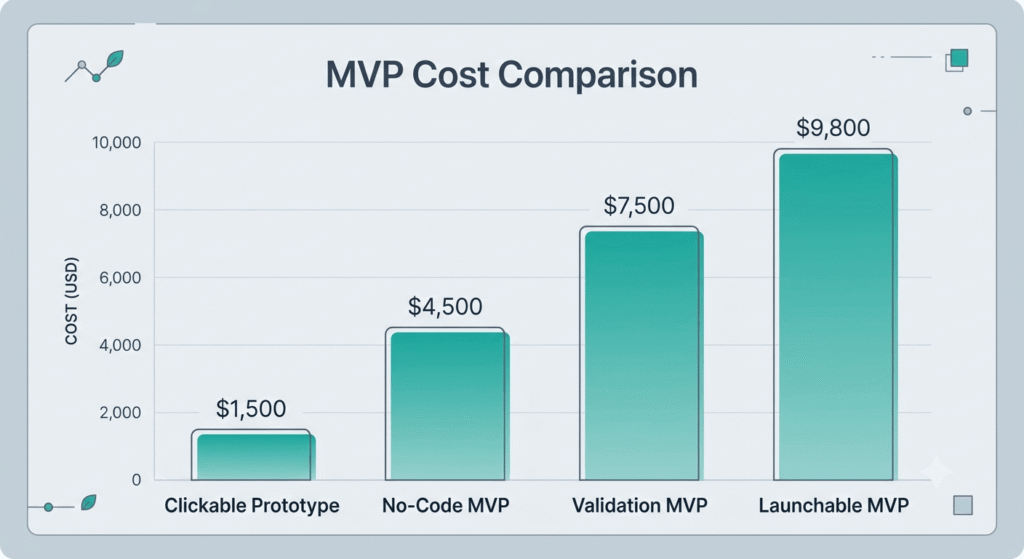
| Clickable prototype | $5,000 to $40,000 | 2 to 6 weeks | People understand and want the flow |
| No-code MVP | $5,000 to $15,000 | 4 to 6 weeks | Demand for a simple workflow product |
| Custom validation MVP | $30,000 to $80,000 | 6 to 12 weeks | Real users adopt the core loop |
| Launchable MVP | $50,000 to $120,000+ | 10 to 24 weeks | The product survives production and payments |
Figures reflect US agencies and freelance teams. Offshore rates run lower, regulated verticals run higher, and teams that handle MVP development end to end usually quote after a discovery call rather than before one.
Common mistakes to avoid with MVP development
The expensive mistakes are all scope mistakes. A v1.0 feature list relabeled as an MVP is the most common one, and it explains why some MVPs cost more than the production apps they were meant to precede. Scope creep of 10% a month compounds quietly across a four-month build.
Two others show up constantly. Building for production scale before you have users locks in architecture you will pay to undo. Launching wide buries the signal you need under a broad audience. If your MVP needs a marketing budget to reach its first hundred users, the scope is wrong.
Your MVP roadmap after launch: persevere, pivot, or stop
Four weeks of real usage gives you enough to decide. Look at activation rate, week-four retention, and time to first value. Compare those numbers to the threshold you wrote in step six, back when you had no emotional stake in the answer.
- Persevere when retention holds and users complain about missing features. Build the next thing they asked for.
- Pivot when people activate but do not return. The problem is real and your solution is not the one they want.
- Stop when nobody activates. CB Insights found the median gap between last raise and shutdown was 22 months, and about a quarter of those companies were effectively dead for three years first.
A useful MVP roadmap stays short: one decision, then the next piece of evidence to go get. This RevSquared AI build shows what the second cycle looks like once the first one produces an answer.
Frequently asked questions
1. What are the stages of the MVP development process?
Six stages: assumption validation, scoping, prototyping, building, instrumented launch, and the decision review. Most US teams spend two weeks on the first two stages, six to twelve weeks building, and four weeks collecting usage data before deciding whether to continue, change direction, or stop.
2. How many features should an MVP have?
Three to five in most cases. Run each candidate through these tests:
- Does the product fail its core job without it?
- Does it help you measure whether users get value?
- Would you delay launch two weeks to add it?
Anything that fails all three belongs in version two.
3. Is an MVP the same as a prototype?
No. A prototype is a clickable design file that simulates the flow without working code, usually built over two to six weeks. An MVP is deployed software real users sign into and use for actual work. Prototype development normally comes first, and it makes the MVP cheaper.
4. Can you build an MVP without writing code?
Yes, for many products. No-code builds on platforms like Bubble or Webflow typically run $5,000 to $15,000 over four to six weeks, and they suit content, booking, and simple workflow tools. Heavy transaction volume, complex permissions, or custom algorithms push you back to code.
5. How do you know if your MVP succeeded?
Activation rate and week-four retention answer this faster than revenue does. A startup MVP that gets people to the core value moment and brings them back a month later has found something real. Signups alone prove nothing, because curiosity is cheap and most of it never returns.
Conclusion
Most of the money wasted on failed products gets spent after the evidence was already available. A disciplined MVP development process front-loads the uncomfortable questions into the first two weeks, when changing your mind is free. Write the assumption, cut to one loop, ship it narrow, and let the number you set in advance make the call.