

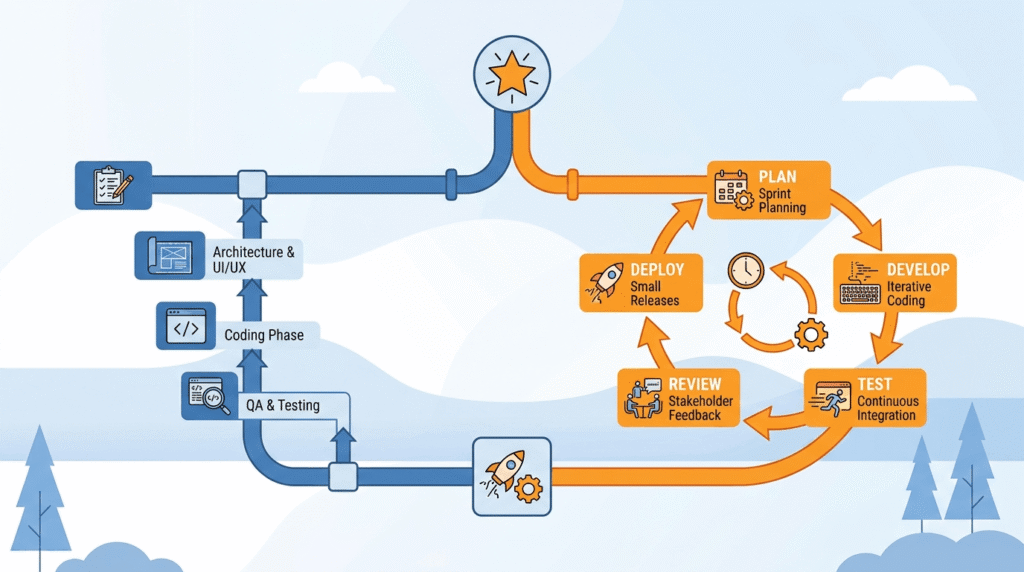
Quick Answer: Agile vs Waterfall comes down to how much you already know. Waterfall locks scope and budget up front, then builds in sequence through defined phases. Agile builds in short cycles and rewrites the plan as users respond. Most MVPs exist to test an assumption, so agile usually wins.
What is Agile vs Waterfall in the software development lifecycle?
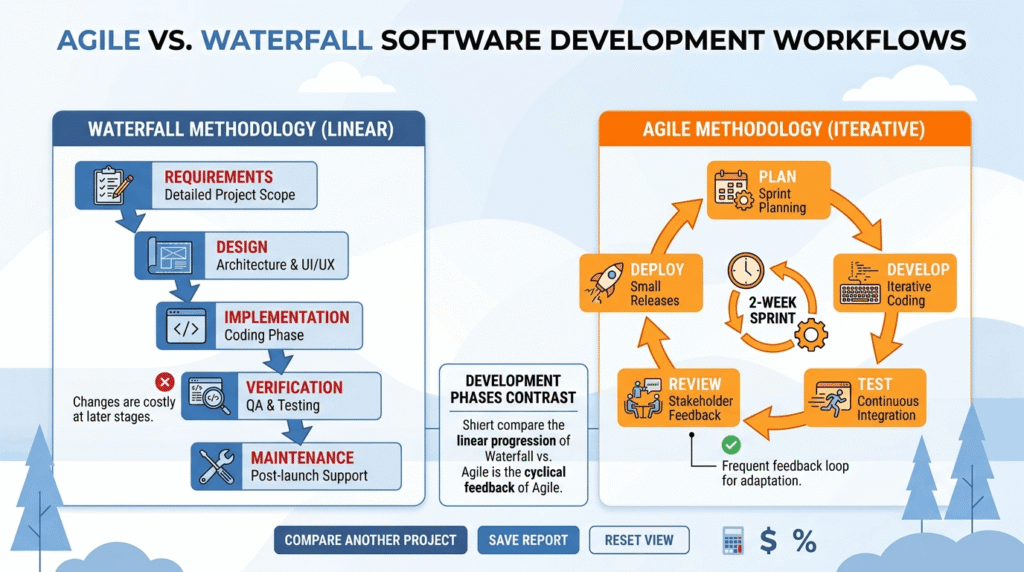
Agile vs Waterfall is a choice between two ways of ordering the software development lifecycle. Waterfall runs requirements, design, build, test, and release as one sequence, with sign-off between phases. Agile runs those same activities inside short repeating cycles, releasing usable software every few weeks and adjusting scope from what users actually do.
The sequential model traces back to a 1970 IEEE WESCON paper by Winston Royce called Managing the Development of Large Software Systems. Here is the part almost nobody mentions: Royce drew the sequential diagram and then called that implementation “risky and invites failure,” proposing feedback loops between phases instead. The method got named after the picture, not the argument.
Agile arrived as a written response 31 years later. Seventeen practitioners met at Snowbird, Utah in February 2001 and published the Manifesto for Agile Software Development, four values and twelve principles that have never been revised since. One of those twelve principles sets the delivery cadence directly: ship working software every couple of weeks to a couple of months, and prefer the shorter end.
How does waterfall methodology differ from agile development?
Waterfall methodology front-loads certainty. You spend weeks writing a specification, price the whole build from it, then execute phase by phase with approval gates between each one. Agile pushes certainty later: you order a backlog, build the top items, show real software to real people, and re-rank everything based on what came back.
Agile methodology in practice
The difference shows up in where change lands. Under a fixed spec, a new requirement in month four is a change order that reopens price and timeline. Under agile methodology, that same requirement is a backlog item somebody moves above three others on Monday morning.
| Decision factor | Waterfall | Agile |
|---|---|---|
| Scope | Fixed and signed off before build | Ordered backlog, re-ranked each cycle |
| First usable release | After the final phase | Every sprint, one month or less |
| Pricing model | Fixed price, quoted from the spec | Per sprint or per iteration |
| Handling change | Formal change order | Backlog reprioritization |
| Best fit | Stable requirements, audit trail needed | Unproven product, unknown users |
Which MVP build strategy gets you to real feedback fastest?
Agile does, by a wide margin, because the whole point of an MVP is buying information. CB Insights’ analysis of startup post-mortems keeps putting “no market need” at the top of the failure list, around 42%. A sequential build hides that answer until launch day. Sprints surface it in weeks.
Think about what each MVP build strategy actually purchases. A fixed spec buys you budget certainty and a document your finance team can approve. Sprints buy you evidence. If you already know exactly what to build and who will pay for it, certainty is worth more. If you are still guessing at the core workflow, evidence is worth more, and an early release with a scoped-down feature set is how you get it. Our Prompt Generator AI case study shows one version of that tradeoff in practice.
Where the Scrum framework fits
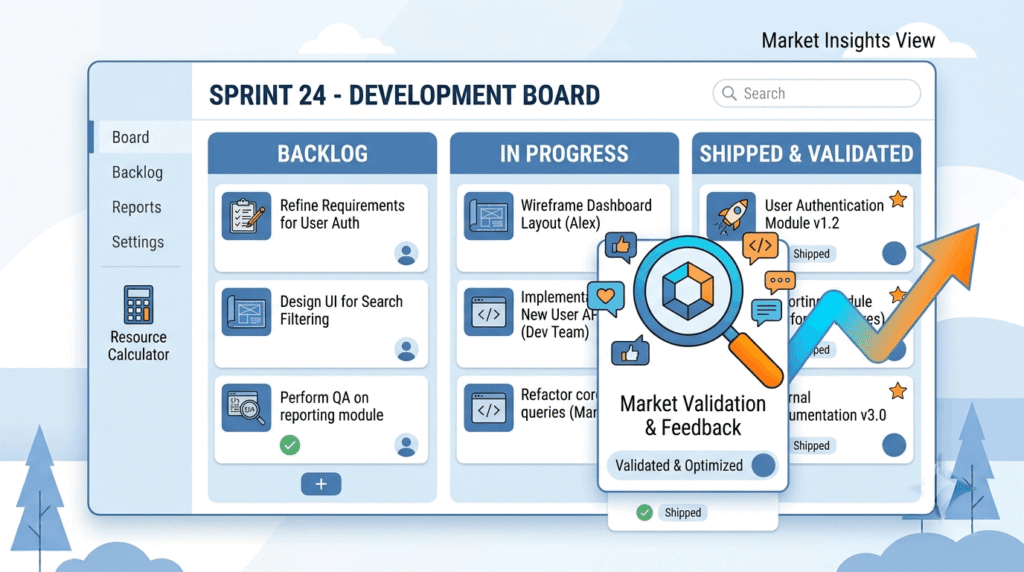
Scrum is the most common way teams run agile, and Scrum.org notes it has topped every State of Agile report since the survey began. The 2020 Scrum Guide is specific about the shape: teams of typically 10 or fewer people, sprints of a fixed length no longer than one calendar month, a 15-minute daily check-in, and a review capped at four hours for a month-long sprint.
That size cap matters for founders. A Scrum team of six can hold an MVP’s full context in one room. Scrum vs waterfall stops being a philosophical argument at that scale and becomes a staffing question: sequential delivery needs analysts, handoffs, and documentation that a six-person team simply cannot staff.
When does the waterfall lifecycle model still make sense?
The waterfall lifecycle model earns its place when requirements come from outside your team and cannot move. Regulated builds in healthcare, finance, defense, and government often require a signed requirements document, traceable approvals, and validation evidence an auditor can follow. Iterating your way toward a compliance standard is not an option.
Fixed-bid client work is the other honest case. If a contract specifies exactly what gets delivered for exactly what price, someone has to write that specification first, and phase gates are how you protect both sides.
Most teams have stopped choosing. Digital.ai’s State of Agile research found roughly three in four organizations now run blended, hybrid, or homegrown processes rather than any framework by the book, with hybrid delivery models leading. A common pattern locks the infrastructure and compliance layer with upfront design, then runs the product surface in sprints. It works when the seam between them is deliberate. It fails when nobody owns the handoff. For teams pairing this with front-end work, our UI/UX design process sits on the iterative side of that line.
Frequently Asked Questions
1. What is the main difference between Agile and Waterfall?
Sequencing. Waterfall completes each phase and signs it off before the next begins, so working software appears once, at the end. Agile repeats the full cycle every sprint, producing something usable every few weeks. The practical consequence: waterfall prices change as a formal variation, agile absorbs it as reprioritization.
2. Can you use Agile and Waterfall together on the same project?
Yes, and most organizations already do. Digital.ai’s State of Agile data shows around 74% of teams run blended, hybrid, or homegrown processes instead of one pure framework. The usual split fixes architecture, security, and compliance decisions upfront, then runs feature delivery in sprints against that foundation.
3. Is scrum vs waterfall the same question as agile vs waterfall?
Not quite. Agile is the mindset defined by the 2001 Manifesto; Scrum is one framework that implements it, alongside Kanban and Extreme Programming. Comparing scrum vs waterfall compares a specific rulebook with sprints, three accountabilities, and five events against a general sequential approach.
4. How long should an MVP take with agile sprints?
The Agile Manifesto’s third principle sets the outer bound: deliver working software every couple of weeks to a couple of months, favoring shorter cycles. The Scrum Guide caps a sprint at one calendar month. Two-week sprints are the common default, which means your first usable increment lands in weeks.
5. Is waterfall still used in software development?
Yes, in specific contexts:
- Regulated software where auditors require signed, traceable requirements
- Fixed-bid contracts with a legally defined deliverable
- Hardware-coupled builds where a manufacturing date cannot move
- Government and defense procurement with mandated phase gates
Outside these, agile and hybrid approaches dominate modern product work.
Conclusion
Agile vs Waterfall is not really a debate about methodology quality. It is a question about how much you already know. If your requirements are fixed by a regulator, a contract, or a hardware deadline, sequential phases protect you. If you are building a first version to find out whether anyone wants it, sprints protect you. Most founders sit firmly in the second camp, which is why our MVP development work runs on short cycles and real user feedback rather than a spec written before launch.