

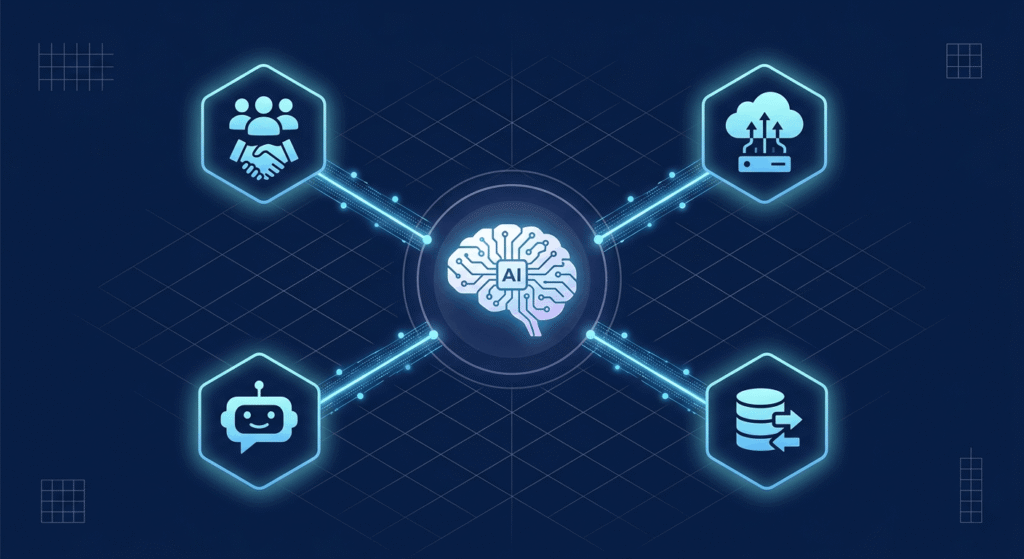
Quick Answer Box: AI integration depends on APIs as the vital bridge between artificial intelligence models and business systems, enabling secure, scalable, and automated workflows. By abstracting technical complexity, APIs unlock rapid AI adoption, drive process automation, and are foundational for modern, future-ready enterprise AI deployment.
What is API Integration in Artificial Intelligence?
API integration in artificial intelligence is the process of connecting AI models—such as machine learning algorithms, natural language processing systems, or computer vision tools—with business applications and workflows using standardized Application Programming Interfaces (APIs). By leveraging APIs, organizations easily add AI-powered capabilities to existing digital products without building or managing complex models internally. APIs transmit data securely and efficiently, enabling repeated, scalable access to intelligent outputs—making advanced AI available to a much broader audience.
The Importance of APIs in Modern AI Integration
APIs are indispensable to modern AI integration, providing organizations with the technical foundation to deploy artificial intelligence solutions at scale. By offering standardized and secure interfaces, APIs enable enterprises to embed powerful AI functions—like text analysis, speech recognition, computer vision, and predictive analytics—directly into their CRM, websites, and workflow tools. According to SQ Magazine, the global AI API market reached $85.43 billion in 2026, with 82% of enterprises using generative AI solutions weekly.
Utilizing APIs accelerates AI integration by reducing time-to-market by up to 60%, as noted by Unizo. This modular approach allows you to choose best-in-class AI services from top platforms such as OpenAI, Google Vertex AI, and AWS AI/ML Services, integrating capabilities like summarization, chatbots, or image recognition as needed. By integrating APIs, businesses break down data silos, automate tasks, and democratize AI—bringing enterprise-grade intelligence even to teams with limited AI expertise.
AI Integration in Real-World Business Context
For example, financial firms can leverage natural language processing APIs for contract analysis, while ecommerce platforms harness computer vision APIs for automated tagging of product images. Healthcare providers can integrate AI-driven analytics APIs into their electronic records systems, enabling advanced diagnostics and patient management. By providing the “connective tissue” between AI models and your business systems, APIs make AI integration not only possible but also practical and cost-effective.
How APIs Work in AI Integration
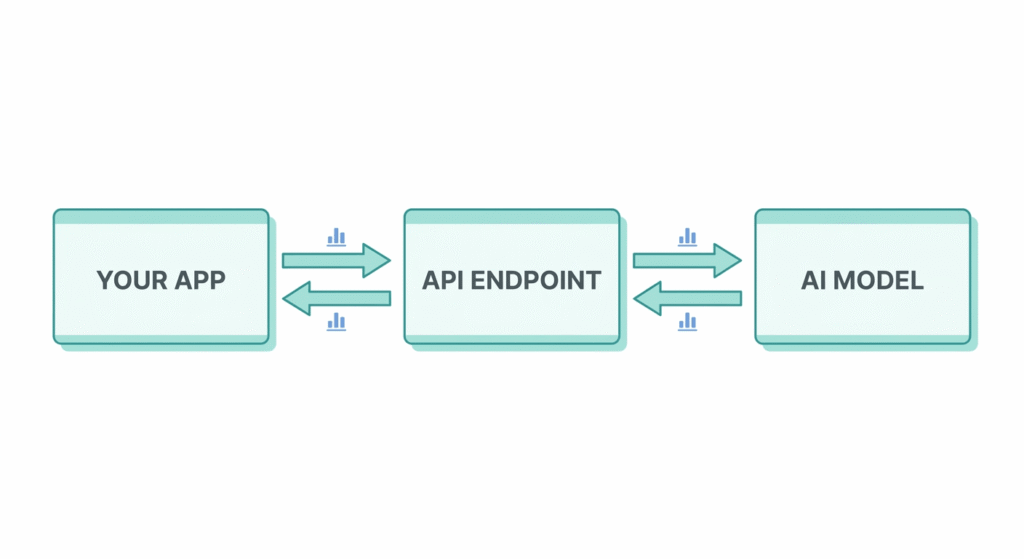
An API in artificial intelligence serves as a conduit that allows your systems to communicate with AI models. You submit input data to a designated API endpoint, triggering the AI to process your request—whether that’s analyzing text, categorizing images, or forecasting trends. The API then returns a structured result, such as a JSON response, for easy integration into your application or business workflow.
API endpoints are specialized web addresses, each representing a distinct AI function. REST and GraphQL are the most common protocols for transmitting your requests. For instance, to analyze customer feedback, you might send a text sample to a sentiment analysis endpoint and receive categorized results seconds later.
The Role of API Gateways and Developers
API gateways add an additional management layer, handling functions like authentication, rate limiting, traffic routing, and monitoring. This ensures that API requests are both secure and reliable across your organization. The API developer is responsible for building and maintaining this logic, creating documentation, and ensuring compatibility between systems. Businesses seeking comprehensive AI integration often engage both an internal API developer and an AI integration specialist for holistic support.
A practical example: By using the OpenAI API, customer support platforms can analyze live chat transcripts, generate instant replies, and escalate inquiries—simply through API calls to OpenAI’s natural language endpoints.
The API Ecosystem for AI Integration
A robust API ecosystem is essential for scalable and sustainable AI integration. This ecosystem comprises several core components:
- APIs: These standardized interfaces allow access to AI models across various domains including language, vision, and data analytics.
- API Endpoints: Each endpoint provides access to a specific function, such as translation or classification.
- API Gateway: This central management layer handles authentication, routing, monitoring, traffic control, and enforces endpoint security.
- Developer Tools: SDKs, code samples, and automated documentation streamline the integration process for both technical teams and business users.
- API Automation: Automation platforms and workflow tools enable orchestration of multiple APIs, scaling operations with minimal manual intervention.
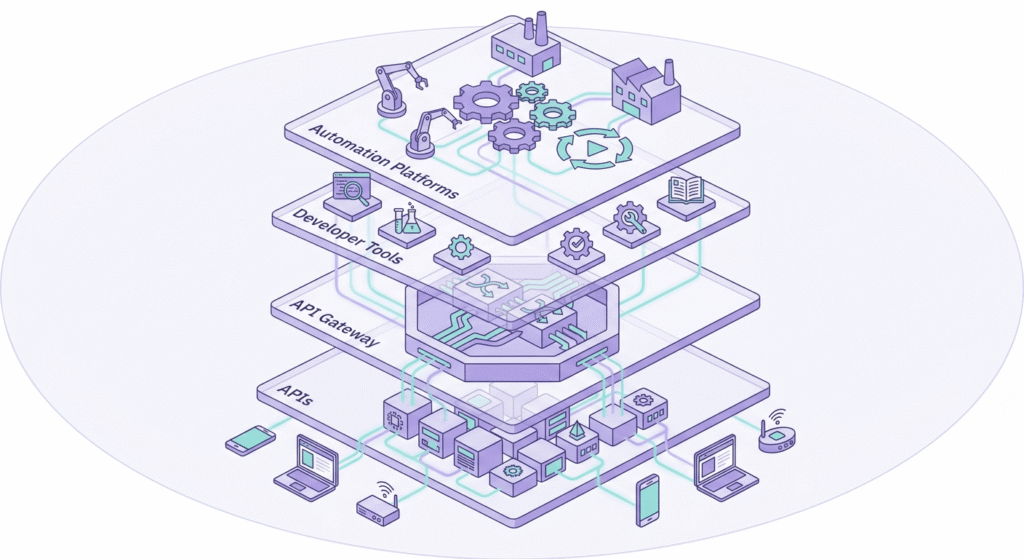
Enterprise API platforms such as Zapier and Make exemplify API automation, connecting thousands of SaaS tools and AI features with minimal code. By leveraging this ecosystem, businesses can automate repetitive tasks, unlock new digital products, and ensure resilient AI integration as systems evolve.
The Expanding API Ecosystem and Its Benefits
As the API ecosystem expands, more businesses adopt low-code and no-code solutions, making AI integration accessible beyond IT. Workflow orchestration and API automation are growing trends, with platforms offering plug-and-play modules for rapid prototyping or production deployment. The future of scalable AI integration depends on an ever-more flexible and robust API ecosystem.
Step-by-Step: Implementing API-Based AI Integration
To implement API-based AI integration successfully, follow these step-by-step guidelines:
- Define Objectives and Outcomes
Clarify your core business goals, such as automating lead qualification or enhancing customer support.
Evaluate where AI can create measurable value and align with strategic priorities. - Select the Right AI API Provider
Compare leading AI API platforms like OpenAI, Google Vertex AI, and AWS AI/ML Services on the basis of security, documentation, scalability, and prebuilt tools.
Consider platforms such as Zapier and Make for workflow automation. - Map Data Flows and Design Integration
Identify the specific data to be exchanged between your applications and the AI API.
Chart out endpoints, data transformations, and workflow architecture. - Develop and Test Connections
Utilize SDKs and sample code provided by your chosen AI API vendor.
Create scripts to automate API calls and integrate error handling. - Conduct API Integration Testing
Test common and edge-case scenarios to validate inputs, outputs, and error management.
Enforce strict endpoint security controls, managing authentication and privacy measures. - Automate and Orchestrate
Configure triggers and workflow automations to keep processes running efficiently with minimal human intervention.
Make use of orchestration platforms for scalable integration. - Monitor, Secure, and Optimize
Regularly track API usage, monitor errors, and validate system security and compliance.
Continuously optimize integrations based on analytics, business feedback, and evolving requirements.

By following these systematic steps, organizations accelerate AI adoption, mitigate risks, and maximize the return on their AI integration investments.
API Integration Testing in AI Workflows
API integration testing is critical in AI workflows to ensure systems interact accurately and efficiently. In AI contexts, this testing is more complex due to often unpredictable or evolving AI model outputs. Effective testing involves designing scenarios reflective of real user interactions and validating that the APIs deliver reliable, accurate, and safe results.
Common approaches to API integration testing include:
- Scenario Design: Prepare both standard and edge-case scenarios reminiscent of the variety seen in real business data such as ambiguous user inputs or very large datasets.
- Simulated Requests: Use mock data to emulate requests and responses, confirming the API’s behavior in error and success cases.
- Input and Output Validation: Check that the data sent and received is formatted and processed correctly by the AI API.
- Error Management: Monitor how the system handles failures—including model unavailability or excessive request sizes.
- Regression Testing: As AI models retrain or update, automated tests ensure continued consistency in outcomes, even as underlying models evolve.
API integration testing is a vital safeguard, reducing the risk of system outages or erroneous results. Businesses with regular AI deployments—such as those developing MVPs (Minimum Viable Products) or AI websites—must make rigorous testing a core part of their workflow. For more on how MVPs benefit from robust API integration, see our MVP Development page and the Prompt Generator AI case study.
API Automation for Scalable AI Integration
API automation is crucial for ensuring that artificial intelligence solutions operate at scale without bottlenecks. By orchestrating workflows and chaining multiple API endpoints, companies can move from experimental pilots to reliable, production-ready operations. Automation tools manage deployment, monitoring, and updates to AI-driven services.
API automation enables:
- Rapid rollout and updates of AI models, with workflows adapting automatically.
- Simple, low-code integration, empowering business analysts or managers to set up automations without developer resources.
- Proactive monitoring and error response, reducing downtime and ensuring consistent output.
- Instant scalability as demand for AI-powered tasks grows.
Platforms like Zapier and Make allow organizations to connect thousands of business tools with AI services, orchestrating tasks across marketing, operations, and customer service. This API automation is essential for companies seeking to harness AI integration for growth and efficiency. For a detailed case study on automating workflows with AI, see our web development case study for RevSquared AI.
Endpoint Security in API-Driven AI Systems
Endpoint security is fundamental in API-driven AI systems since APIs often process sensitive corporate or customer data. A weak or unprotected API endpoint can expose businesses to data leaks, disruption, and regulatory fines.
Essential strategies for securing API-driven AI systems include:
- Authentication and Authorization: Implement OAuth, API keys, or similar standards to ensure only verified users and systems have access.
- Encryption: Use TLS/SSL to safeguard data in transit, mitigating interception or tampering risks.
- API Gateway Controls: Employ API gateways to enforce rate limiting, manage traffic, log events, and block suspicious activity.
- Ongoing Monitoring: Leverage automated monitoring tools to promptly detect and respond to security threats or data anomalies.

Strict adherence to data protection regulations like GDPR or HIPAA is necessary for industries handling health, financial, or personally identifiable information. As attackers become more sophisticated, it is vital to continually review and update endpoint security strategies—an area where partnering with an AI integration specialist pays dividends. For in-depth discussions of best practices, review our resource on AI API endpoint security best practices.
Comparing API Integration Approaches for AI
| Approach / Platform | Pros | Cons | Best Use Cases |
|---|---|---|---|
| **REST APIs** | Universally supported, easy to learn | Verbose for advanced queries, sometimes rigid | CRUD data, basic business integrations |
| **GraphQL APIs** | Flexible data selection, efficient retrieval | Steeper learning curve, newer to some teams | Interactive UIs, diverse data needs |
| **Direct Integration** | Customization, maximum performance | More effort to maintain, tight coupling | Internal, mission-critical tools |
| **API Gateway** | Centralized security, analytics, scalability | Initial setup is complex, adds management layer | Large organizations, public APIs |
| **Open API Platforms** | Quick startup, thousands of connectors | Limited in-depth customization, possible lock-in | SaaS, fast prototyping, automation |
Choose REST APIs for broad compatibility, GraphQL for flexible queries, and API gateways when scaling is critical. Open API platforms excel for rapid integrations and workflow automation. For an in-depth comparison, read our article on custom vs. off-the-shelf AI APIs.
API Ecosystem: Choosing the Right Solution
When selecting among these integration approaches, consider your organization’s size, regulatory environment, technical expertise, and future growth. The right API ecosystem will provide security, adaptability, and long-term support for evolving AI needs.
Common Mistakes in API-Driven AI Integration
Despite the promise of accelerated AI integration via APIs, some pitfalls regularly hinder implementation:
- Ignoring Endpoint Security: Lax authentication and rate limiting may expose APIs to data breaches.
- Incomplete API Integration Testing: Skipping thorough testing results in brittle systems susceptible to errors and unpredictable outputs.
- Insufficient Data Validation: Accepting unverified data, or not checking AI-generated results, can introduce bias or poor-quality conclusions.
- Poor API Documentation: Vague or missing documentation increases debugging time and raises integration costs.
- Lack of Ongoing Maintenance: Rapid model evolution can leave unmonitored APIs out of sync, leading to process failures and compliance risks.
Understanding and proactively addressing these risks ensures your API-driven AI integration is scalable, secure, and sustainable over time.

FAQs
1. What is API in artificial intelligence?
An API in artificial intelligence is a standardized interface that lets applications connect and interact with AI services or models. With an API, your app can send data to an AI system, such as OpenAI’s GPT-4, and receive actionable results—like language analysis, image classification, or predictive analytics—without having to build or maintain the underlying AI.
2. How do APIs enable AI integration across enterprise systems?
APIs enable AI integration by delivering a universal communication channel between business tools and advanced AI models. For example, an API might allow a company’s CRM to automatically categorize support tickets using sentiment analysis or detect fraud by analyzing financial transactions, all within existing platforms.
3. What is API integration testing in AI projects?
API integration testing in AI projects checks that business systems interact properly with AI APIs. This involves sending different data types and scenarios, validating the AI’s responses, managing errors correctly, and verifying that authentication and endpoint security work as intended—even as AI models evolve or endpoints change.
4. Why is endpoint security critical for AI-powered APIs?
Endpoint security is crucial because APIs handle sensitive business and personal data. Without robust measures such as authentication, encryption, and continuous monitoring, systems are vulnerable to data theft and service disruption. Protecting API endpoints is fundamental for safe and compliant AI adoption across industries.
5. Who is responsible for successful AI API integration?
Successful AI API integration requires collaboration among API developers—who design and maintain connections—AI integration specialists who align AI with business strategy, IT security professionals responsible for safeguarding data, and business stakeholders who set the project’s goals. Each plays a key role in robust and effective AI integration.
Conclusion
AI integration is revolutionizing business operations, with APIs serving as the essential infrastructure for secure, automated, and scalable deployment of artificial intelligence. By adopting an API-first approach, organizations can accelerate automation, maintain robust endpoint security, and ensure rapid adaptation to technological change—positioning themselves to thrive in the era of smart automation and continuous innovation.