

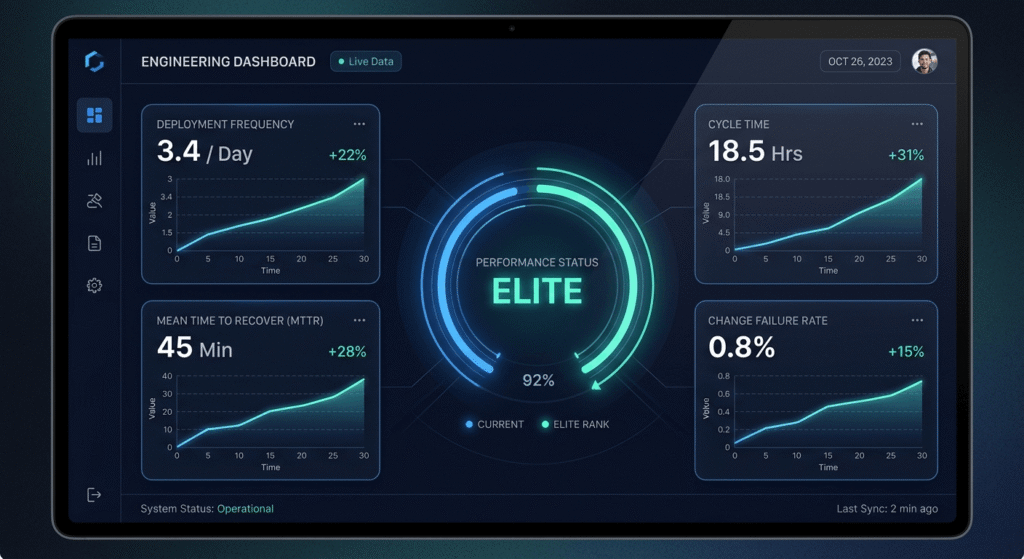
Quick Answer Box: Software KPIs are core metrics used by organizations to measure and improve software development success in 2026. These key metrics, including cycle time, deployment frequency, MTTR, and team velocity, help identify bottlenecks, monitor progress, and tie technical work to real business impact. Automated KPI tracking is vital for reliability.
What are Software KPIs?
Software KPIs are targeted, quantifiable metrics that track how effectively software development teams deliver value in 2026. These metrics, such as cycle time, deployment frequency, MTTR, and team velocity, help engineering leaders understand strengths and bottlenecks in delivery speed, product quality, and impact on customers. By using software KPIs, companies align technology outputs with organizational objectives and drive continuous improvement in business results.
What Are the Main Types of Software KPIs and Why Do They Matter in 2026?
Software KPIs fall into four main types: flow and delivery metrics, quality and reliability metrics, productivity and team health metrics, and outcome or business-oriented metrics. Each category provides unique insight into the development process, helping organizations detect bottlenecks, uncover strengths, and connect engineering performance to tangible business outcomes.
Flow and delivery metrics like cycle time and lead time assess how efficiently work items move through the development pipeline. Quality metrics such as bug rate and change failure rate allow teams to maintain high standards while shipping fast. Productivity and team health metrics, including velocity and developer satisfaction, ensure that teams are motivated and effective. Finally, outcome metrics such as customer satisfaction and uptime show how engineering efforts translate into business value.
Top teams in 2026 rely on a balanced set of these key metrics, using automated dashboards like Planview AdaptiveWork and Cortex to monitor and optimize performance in real time.
Flow and Delivery Metrics
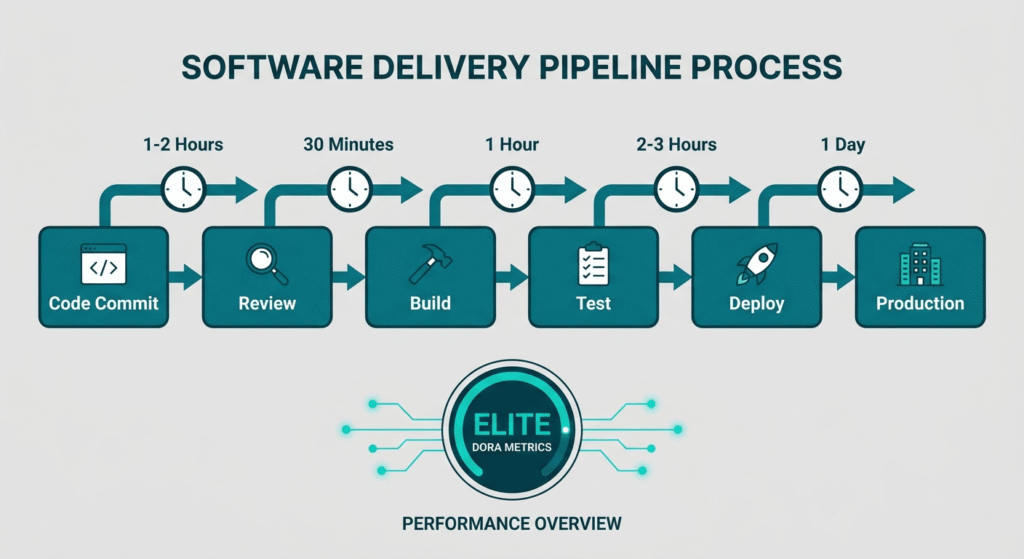
Flow and delivery metrics reveal how quickly features and fixes pass through the software pipeline. In 2026, high-performing teams pay close attention to these metrics for continuous improvement.
- Cycle Time: This measures the period from starting work on a task to when it’s completed. Elite engineering organizations report cycle times in hours rather than days, improving adaptability.
- Lead Time: Lead time tracks the total duration from a new request or commit to release in production. Short lead times show strong responsiveness to customer needs and business requirements.
- Throughput: The number of completed work items, such as features or bug fixes, within a given timeframe. High throughput indicates consistent delivery and strong team capacity.
Teams that leverage automated dashboards such as Planview AdaptiveWork can easily visualize, benchmark, and optimize these metrics, leading to greater process predictability.
Quality and Reliability Metrics
Quality and reliability metrics are critical for maintaining trust and minimizing defects, especially as development speeds accelerate.
- Bug Rate: Tracks the number and severity of defects identified.
- Change Failure Rate: The percentage of deployments causing production issues. DORA elite teams keep this under 15% for stability.
- Rework Rate: Measures how much work must be revised due to errors or changing requirements.
Monitoring these software KPIs ensures teams catch issues early, keep failure rates low, and avoid compromising product stability for speed.
Productivity and Team Health Metrics
Measuring productivity and team health helps teams avoid burnout and deliver sustainable results in 2026.
- Team Velocity: Average work output per sprint, usually in story points or task count, aids sprint planning and forecasting.
- Developer Satisfaction: Regular employee surveys (such as SPACE or DevEx) indicate morale and retention risk.
- Workload Balance and Focus Time: Comparing planned and unplanned work gives insight into how teams manage interruptions and maintain focus, which is critical for healthy, productive developers.
Attention to these KPIs strengthens productivity, reduces turnover, and ensures high-quality outcomes as companies grow.
Outcome and Business Metrics
Outcome metrics ensure engineering work creates measurable value for customers and the business.
- Customer Satisfaction: Net Promoter Score (NPS) and direct user feedback quantify product impact and user happiness.
- Uptime: Measures the availability of applications or services, a direct indicator of platform reliability.
- SLA Adherence: Tracks fulfillment of service-level agreements, reflecting reliability commitments to customers.
Combining outcome KPIs with technical metrics gives leaders a full view of performance and aligns efforts across teams.
DORA Metrics: The Gold Standard for Software Engineering Success
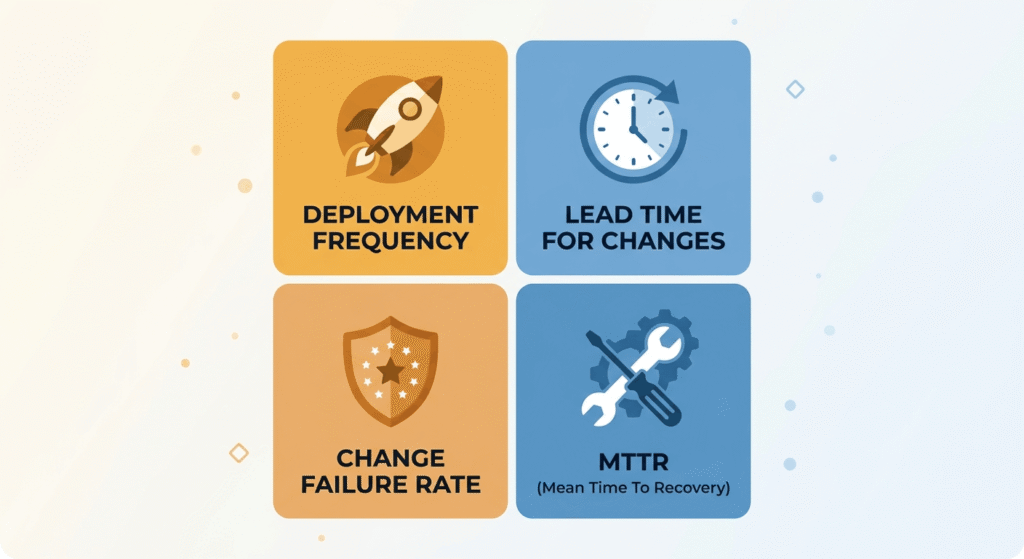
DORA metrics, pioneered by the DevOps Research & Assessment (DORA) team, set the standard for engineering metrics in 2026. These four core metrics—deployment frequency, lead time for changes, change failure rate, and mean time to recovery (MTTR)—are used worldwide to benchmark delivery performance.
- Deployment Frequency: Tracks how often code is pushed to production. Elite teams deploy several times daily.
- Lead Time for Changes: Measures how rapidly code moves from commit to release. Efficient teams manage this in hours.
- Change Failure Rate: Indicates the proportion of releases with failures. The industry target is below 15%.
- MTTR: Mean time to recovery reflects how quickly teams restore service after an incident, with leaders resolving issues in minutes to hours.
By tracking DORA metrics, organizations identify delivery roadblocks, boost deployment confidence, and foster DevOps culture. Automated monitoring through tools like Cortex brings these engineering metrics into daily practice.
DORA Metrics 2026 Benchmarks
Recent industry data show that teams achieving elite DORA metrics see higher employee satisfaction, improved customer trust, and faster go-to-market speeds. Monitoring trends in DORA benchmarks helps companies gauge how they compare globally and set realistic improvement goals. For more details, see “DORA Metrics Benchmarks for 2026: What Elite Teams Are Achieving.”
Engineering Metrics vs. Agile Metrics: What’s the Difference?
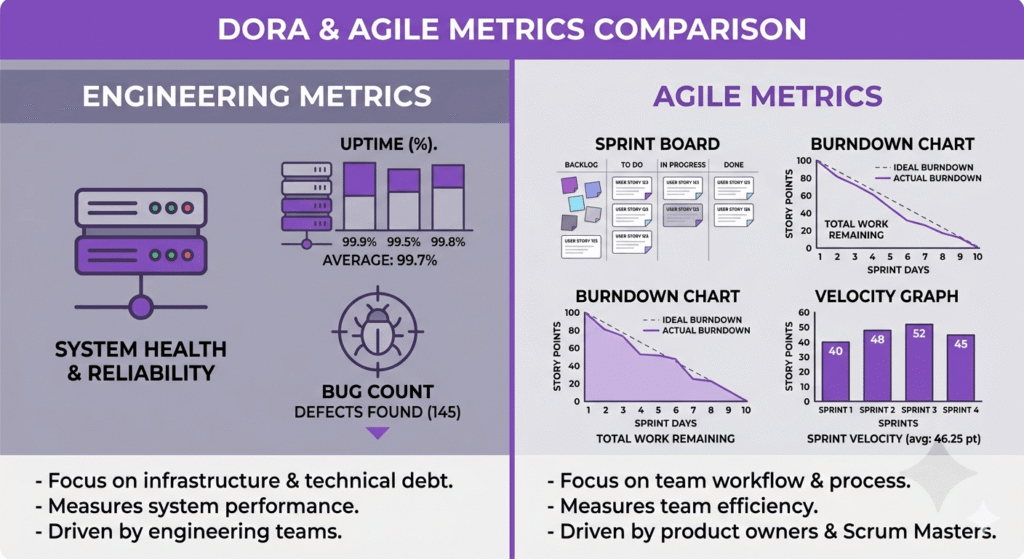
Engineering metrics measure system-wide performance, process health, and reliability, including indicators like MTTR, uptime, deployment frequency, and code maintainability. These metrics form the backbone of modern DevOps and help organizations monitor progress toward long-term technical goals.
Agile metrics, on the other hand, focus on project-level flow—evaluating team performance in sprints using indicators such as team velocity, cycle time, work in progress (WIP), and burndown charts. These metrics optimize sprint planning, enhance predictability, and aid in continuous delivery.
While both types of metrics share the goal of improvement, engineering metrics give a broad view of system health, while agile metrics provide tactical insights for day-to-day workflow. Successful teams use both. For more on agile metrics integration, see Design for a UI/UX perspective and MVP for agile project alignment.
Comparing Key Software KPIs: A Quick Reference Table
| Metric Type | Key Example(s) | What It Measures | Typical Use Case |
|---|---|---|---|
| DORA Metrics | Deployment frequency, MTTR, lead time, change failure rate | Delivery speed, resilience, quality | CI/CD optimization, executive review |
| Engineering Metrics | Code output, uptime, bug rate, rework rate | System health, productivity, maintainability | Ops management, benchmarking |
| Agile Metrics | Team velocity, cycle time, WIP, burndown | Workflow flow, sprint/process predictability | Sprint planning, retrospectives |
Use this reference to quickly compare how different software KPIs align with your organization’s growth priorities.
How to Choose and Track the Right Software KPIs in 2026
Choosing relevant software KPIs and tracking them reliably turns raw numbers into real improvement. Here are the essential steps for 2026:
Step 1: Align KPIs with Business Objectives
First, ensure each KPI directly links to a core business goal, whether that’s faster MVP launches, improved user satisfaction, or elevated quality standards. For example, early-stage startups may prioritize cycle time and customer satisfaction, while established companies might emphasize MTTR and uptime metrics.
To match KPIs to business priorities, collaborate with your tech and product leadership. See Development and MVP resources for best practices in goal alignment.
Custom KPI Dashboard Software Development
Consider building or customizing dashboards tailored to your team’s agile process. A custom KPI dashboard for software development lets managers visualize delivery metrics and outcomes at a glance, facilitating better decisions across product and engineering.
Step 2: Select Trackable and Actionable Metrics
Strong KPIs are clearly actionable, tracked automatically, and aligned with outcomes—not just activity. Criteria for selection include whether the KPI can influence decisions, if the data is consistently collected, and if the metric stays relevant to current technical and customer goals.
Limit tracking to 5–8 core metrics per team. Avoid vanity measures like lines of code, as these rarely reflect true progress.
Step 3: Automate KPI Data Collection
Manual reporting doesn’t scale in 2026. The best KPI software automates metric collection for accuracy and real-time visibility.
- Top platforms include:Planview AdaptiveWork: Enterprise dashboards, deep reporting, seamless integration.
- Cortex: Automated engineering health analytics.
- Mooncamp and SimpleKPI: Customizable, user-friendly solutions ideal for both large organizations and kpi software for small business.
- AchieveIt: Comprehensive performance management.Inspire Software: Integrates KPI tracking directly with agile team management for SMBs.
These tools boost accuracy, speed, and cross-team transparency without high onboarding hurdles.
Step 4: Monitor, Analyze, and Iterate
Once the right metrics are in place, review them regularly—weekly or at least bi-weekly. Use dashboards and automation tools to identify outliers, conduct root-cause analysis, and spot improvement opportunities quickly.
Leverage real-world examples, like the Prompt Generator AI and High-Converting Website for RevSquared AI, to better understand how actionable software KPIs create measurable development gains.
Best KPI Software for Development Teams in 2026
Selecting the best KPI software in 2026 involves more than just checking feature lists—it means choosing a platform that aligns with DevOps practices, integrates with issue tracking, and offers customization for your workflow. Here are leading options for every team size:
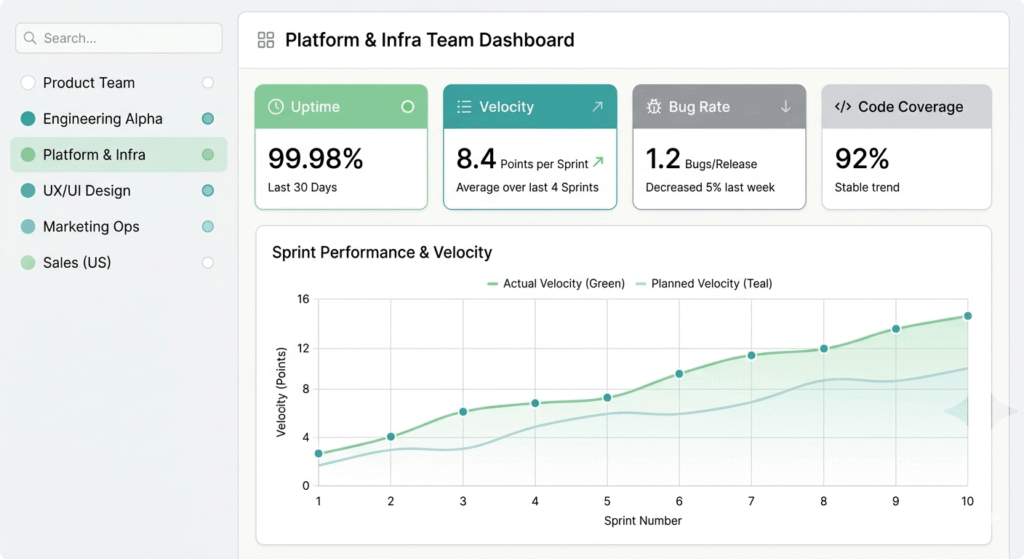
- Planview AdaptiveWork: Ideal for enterprises, this solution offers real-time analytics, deep integration, and strong support.
- Cortex: Focused on automated DORA metric monitoring and team health visualization.
- SimpleKPI: Easiest onboarding for small businesses; intuitive dashboards.
- Mooncamp: Custom KPI tracking with modular reporting.
- AchieveIt: For organizations needing both strategic and operational KPI support.
- Inspire Software: Best for SMBs needing KPI tracking combined with agile workflows.
When evaluating the best KPI software, ensure it fits natively into your development pipeline for high adoption rates and actionable data.
Software Testing KPIs: Ensuring Quality at Every Stage
Software testing KPIs are specialized metrics that QA teams use to guarantee quality and stability throughout the development life cycle.\
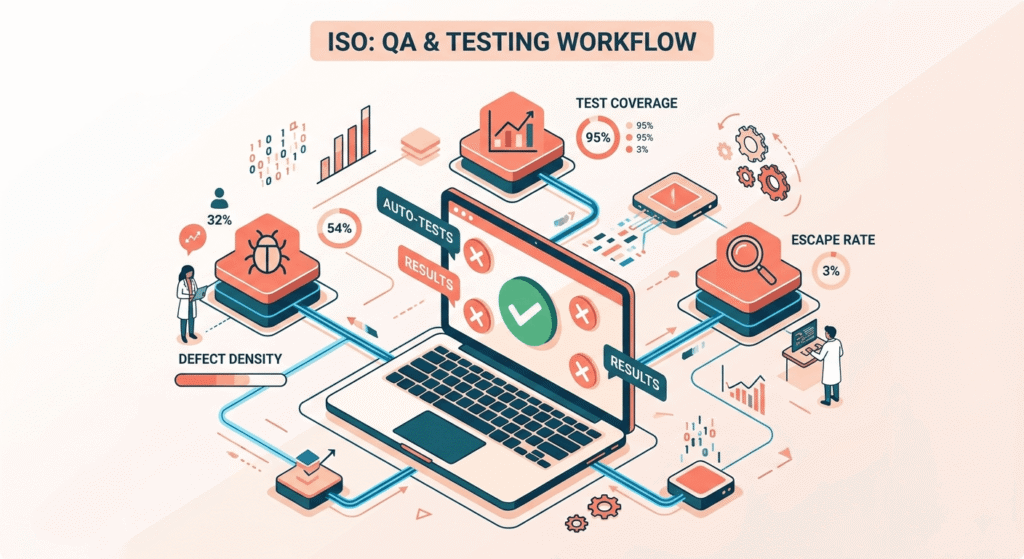
- Defect Density: Measures bugs per thousand lines of code, highlighting baseline code quality.
- Test Coverage: Reveals the percentage of code reached by tests, predicting future stability.
- Automated Test Pass Rate: Monitors what proportion of tests succeed in CI/CD pipelines, reducing regression risk.
- Test Execution Time: Assesses the efficiency of running all automated test suites—faster times provide quicker feedback loops.
- Escape Rate: Percentage of bugs discovered post-release, highlighting any QA process gaps.
Including these software testing KPIs alongside delivery and engineering metrics offers a complete view of risk, quality, and readiness for release.
Common Mistakes When Using Software KPIs
Teams often encounter pitfalls in KPI adoption, including:Tracking Too Many Metrics: Excessive KPIs dilute focus. Stick to a short, meaningful set per team.
- Relying on Vanity Metrics: Metrics like commit count rarely tie to actual improvement.
- Emphasizing Individual Over System Metrics: Team/system KPIs, such as cycle time or MTTR, foster collective responsibility.
- Overlooking Metric Interdependence: Increasing deployment frequency without checks can raise failure rates. Track metrics in context.
- Letting Metrics Stagnate: As business models or technology shift (including AI-driven changes), review and revise your KPI set to stay relevant.
Reviewing what has worked for others through resources like Forbes on 2026 KPIs can also help avoid common mistakes.
How Can You Decide on the Right Software KPIs for Your Team in 2026?
Choosing the right software KPIs for your context requires evaluating company goals, technical environment, and team structure. Effective decision-making follows these steps:
- Clarify whether your focus is rapid innovation, enterprise reliability, or customer impact.
- Select a representative set from each major category (delivery, quality, team health, business outcome).
- Ensure your chosen KPI software supports needed dashboards, integrations, and automation.
- Align your pick with both technical and business stakeholders for buy-in and meaningful results.
If you’re looking to tailor KPIs to your specific environment, reach out to Development, MVP, or submit a request via Contact Us. For insight into core company values, visit Our Story.
FAQs
1. What are the most important software KPIs to track in 2026?
In 2026, key software KPIs include cycle time, deployment frequency, MTTR, change failure rate, team velocity, bug rate, customer satisfaction, and uptime. Monitoring these central metrics provides teams with a clear view of delivery speed, code quality, and business results.
2. How do DORA metrics improve software delivery?
DORA metrics provide a systematic framework for evaluating and enhancing how software is delivered. By tracking the four metrics—deployment frequency, lead time for changes, change failure rate, and MTTR—teams can see where their process slows, implement improvements, and strengthen both reliability and efficiency.
3. What’s the difference between agile metrics and engineering metrics?
Agile metrics center on managing sprint and workflow processes—like velocity and WIP—while engineering metrics track holistic system health with indicators such as deployment frequency and uptime. Both types are needed in 2026 for a complete understanding of progress and risk.
4. Which KPI software is best for small businesses?
For smaller teams, SimpleKPI and Mooncamp are standout options, offering user-friendly dashboards, automation, and cost-effective pricing. Their integrations with popular project management tools help small businesses track KPIs efficiently without extra overhead.
5. How often should software KPIs be reviewed?
Most high-performing teams review software KPIs weekly or every two weeks, relying on live dashboards for instant insight. Regular review helps organizations catch issues early, analyze trends effectively, and make the quick adjustments needed for ongoing success.
Conclusion
Software KPIs are essential for driving reliable development success in 2026. By focusing on actionable, system-level metrics such as DORA benchmarks, cycle time, team velocity, and software testing KPIs, and using the best KPI software for automation and insight, organizations can track progress, uncover bottlenecks, and maximize both engineering excellence and business growth.